 |
| Road to Coffee Plantations. Quiché. |
Guatemala is known all over the world for its wonderful scenery, its diverse culture, but above all, for its excellent coffee!
By. Josue Morales But what exactly is it that makes Guatemala's Coffee so special? To understand Guatemalan Coffee, one must understand Guatemala first. The name "Guatemala" comes from the ancient mayan meaning "land of many trees." Which only helps describe even better the nature of coffee growing in this country where 98% of coffee is shade grown. Using shade is an agricultural practice that provides priceless nurture to coffee plants, it provides the perfect natural setting for coffee to be grown under unique land and climate factors. The main
natural occurring influences in coffee are:
HIGH ALTITUDES: The finest coffee in Guatemala is cultuvated between 4,300 and 6,500 feet above sea level. Which are extremely high altitudes at which coffee production may only be achieved by shade forests and our next factor.
 |
| Burning flame at Coffea Roasters Guatemala. |
MORE THAN 300 MICROCLIMATES: In a relatively small geographical area, 108,889 square kilometers, this can only be explained by the many geogrphic influences present in Guatemala such as a large number of Volcanoes, vast Crater Lakes, High Plateaus and Ranges, along with the Atlantic and Pacific Oceans. All combine to create significant flavor differences among the different coffee regions in this country.
CONSISTENT RAINFALL PATTERNS: Annual rainfall in Guatemala ranges between 32 and 200, and constitutes our third natural factor in coffee excellence. Rain in Guatemala is not only plentiful, but in many ways predictable. With a heavy rainy that provides perfect development conditions for the coffee plant, with an added value of atleast one heavy rain in summer that allows for the coffee flower to blossom.
 |
| Clouds over Guatemala City. |

 On February 25, I traveled with Norma Alcántara and Dina Córdoba of Coffee Kids’ partner, Self-Managed Development (AUGE), to visit the Chajulense Association of Women United for Life (ACMUV), our partner in San Gaspar Chajul, Guatemala.AUGE has extensive experience in microlending and savings programs and Coffee Kids coordinated a meeting between the groups so they could learn and share information. After a six-hour ride from Antigua, we reached the beautiful hills of Chajul.ACMUV’s representative Juana Hu Mateo and the women of the board gave us a warm welcome. For three days, women from both organizations shared their achievements, needs, hopes and ideas in the field of microcredit. During the sessions, members of ACMUV were curious about the role of savings, which is a pillar of AUGE’s microcredit program used by more than 3,000 women in Veracruz, Mexico.The discipline, dreams and strength of the women in Chajul were inspiring to Norma and Dina.“We had worked with many women in Mexico, but the courage and determination of the indigenous women of Chajul is a real motivator for us,” Norma Alcántara said.
 Personally, I was impressed by how the board of ACMUV had been able to organize the meeting and necessary materials with very limited resources. During my previous visit to Chajul in August 2008, ACMUV board members had limited experience with computers and the internet, but through organizing this event, they learned quickly and were able to use the technology on a regular basis, improving their management skills and self-confidence.In a region that just a few years ago suffered under the scourge of civil war, and now struggles with high illiteracy and mortality rates, ACMUV is helping women and their families overcome poverty. Today, ACMUV provides 85 women with access to credit in order to start their own small business and generate income for their families. The visit from Norma and Dina helped the women of ACMUV focus their efforts.
 At the final session, ACMUV member Marta Margarita Velasco Chel expressed in the local Ixil dialect, “I think womens’ groups women that focus on saving and solidarity, like the ones explained by AUGE, can be very good for us. With the solidarity groups we explain what we are going to do with the funds, but we can be confident the group will help us.”Our visit ended with an activity where each woman had a balloon representing her dreams. Like a balloon, our hopes and dreams fly, but occasionally they fall. The important thing is to help each other up so that our dreams can fly again.
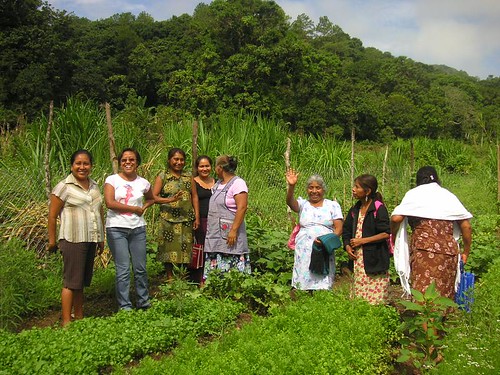 As I watch my own humble garden grow, I realize that the power of growing your own food isn't so much the nutrition as it is the satisfaction found in putting a seed in the ground and watching it emerge, grow and provide sustenance.Many of our partners are working with coffee-farming families to help them create small organic gardens that provide healthy vegetables and fruits and help build economic independence and health. Our program staff made some great pictures of one program managed by our partner FomCafé in Oaxaca, Mexico.
