All Posts (26)
Sort by
"Are we having corn tonight mother? Could you please pass the sugar? No...just give me the bag."
You may be wondering to yourself, "Joshua, dear sir, what does this have to do with coffee?" Well, I've noticed a growing trend in the coffee industry that harkens back to my days as a kid cracked out on sugar. I believe that many people think coffee is good for them. So, in keeping with their childhood rebellions, they want to cover the nasty coffee up with large amounts of unhealthy stuff. A large, extra-sweet, carmel, vanilla, hazelnut, and white-chocolate mocha isn't a drink; it's unresolved childhood angst.
The obvious solution to this pandemic is to conduct a massive campaign aimed at helping coffee drinkers confront their personal aversion to eating healthy food, but I think there is a subtle solution that should not be ignored. We should just make everyone think that coffee is really unhealthy. Think about it. Cigarette boxes have pictures of black lungs on the front that tell you "beware of the smokey death contained in this package" and people love them. Humans are actually very self destructive. If the front of every coffee shop in America had a picture of a cracked-out hobo with brown teeth that read, "this is your life on coffee and -plus- coffee kills kittens," we would be fighting the customers off with a stick. So the next time you're in a coffee shop, don't cover up the taste of your coffee with sugar or excessive amounts of milk. Just remember that coffee kills kittens and I promise it will satisfy your sadistic craving for sugary death. Heck, it's so bad for you that you might even want to quit smoking just to balance things out.
In reality, there are only a couple of things that happen to espresso over the course of a few minutes. First, the crema or foam that sits on top of the espresso reintegrates with the liquid. Crema, on its own, contains some of the best flavors and aromatic qualities of the espresso in high concentrations. Drinking it straight can be overwhelming but, it stands to reason, that having the crema reintegrate might actually be a good thing. Second, the espresso cools down. The temperature of espresso has a lot to do with how we taste the various flavors contained within it and, in fact, our taste buds have many microscopic channels called TRPM5 that increase the bud's sensitivity at higher temperatures. If, however, espresso passes a certain temperature (the exact temperature being unique to every person) it will burn our tongues and greatly decrease our ability to taste. Given that espresso typically comes out of the machine at about 200 degrees Fahrenheit, a fresh shot can easily burn off our ability to taste its liquid-y goodness or numb us to its heave-worthy horrible-ness. In essence, a shot that has sat for about a minute may actually be a better representation of the espresso than a fresh one.
I don't know how the rumor of "dead shots" got started but I do know if you work at a shop that serves poor coffee (or poorly serves great coffee) it would be advantageous to let people drink the shots hot. That way their burnt taste buds won't be able to tell them that they're drinking something awful.
I don't know if this judgement comes from the specialty coffee industry in the United States having grown up with the grunge movement or from the twenty-somethings that seem to populate most barista positions. All I know is that the oddity of a barista or shop is directly related to their perceived quality. I also know that I am probably vastly limiting myself in my perception of a quality coffee shop. So I promise from here on out to not blow off a coffee place, whether it be a shop or drive-through, based on the Hollister shirt that the barista is wearing. I'll blow them off for having bad coffee. I will say, though, that when I noticed that Stumptown was playing their music on a vinyl record player I also noticed a significant improvement in their espresso.
On the surface it may seem as if the fully-automatic machine would be the most highly sought-after type by baristas, but baristas are a hipster bunch and the automatic is way too "in" to be cool. This is one of the few areas in which I totally agree with the hipsters (in case you were wondering). I cannot stomach the thought of using a "super-automatic" to serve real customers and, while I agree that electronics really clutter up the retro feel of an espresso machine, I have a few other reasons as well.
What if you went to your favorite bar with your buddies on a Friday night looking to have a good time. Well, maybe to hit on Jonny's hot friend, but you can't say that out loud because he's already made it clear that she is off-limits and, while you respect Jonny, you're planning on hitting on her after a few drinks and blaming the alcohol. The point being that you're at a bar. So you coolly stride over to the counter and order an Appletini (don't judge). Then the bartender turns toward a large machine, puts a glass under a spout at the bottom, presses a button, and a thick green liquid oozes into your glass. The bartender then turns to you and says, "that will be five dollars, please." If you felt a turn in your stomach just now, I can explain why. Number one, when I order my Appletini at a bar, I expect the bartender to take the time and energy necessary to convince me that they are performing a magical ritual to summon my drink into existence. Two, there is something about an automatic drink-making machine that says to me, "you just paid five dollars for an extended stay on the toilet in about three hours." These same principles are at work, believe it or not, every time somebody serves you or me from an automatic machine at an espresso bar.
The reason that a similar feeling of dread doesn't come over us when our barista employs the same "insert cup, press button" strategy of drink making is also two-fold. First, the shops that use these machines don't typically design them so customers can see how the drink is being made. Secondly (and probably more importantly), most people don't have any conception of how good it could and should be. Most of our collective experience with coffee revolves around grandma and grandpa's canned coffee or a chain store's version of a latte made of 80 percent sugar, 10 percent bad coffee, and 10 percent mystery ingredient. The fact of the matter is that there are coffee shops that not only have great coffee but employ baristas that create drink magic and make five dollars seem like a great deal. Bottom line: I don't like fully-automatic espresso machines and do yourself a favor: the next time you have to have a Caramel Macchiato, spend a little time finding a great shop that doesn't make you pay five dollars for a trip to the restroom.
I'm just an average-looking white guy who loves the art of coffee. I am not a guy that you would pick out of a crowd as somebody qualified to discuss the finer aspects of ristretto shots. I am just a person that loves learning and this blog is a place for the person that goes to their local coffee shop, orders a grande, and doesn't understand why the barista gives them the "hate stare."
Ethiopia Gedeo
Southern Oromia region, bordering on Sidamo and Guji
Acid: medium
Body: medium-low
Texture: berry juice, powdered candy
Flavor profile: sweet natural process coffee cherry from Sidamo displaying a subtle but prototypical lemon and blueberry aroma both dry and wet. More layered than other natural yirgacheffe coffees, flavors of peach, raisin, grape, danish pastry and even lemon-bar. The acid is mild and lightly juicy allowing for a long clean finish surrounding the pulverized hard candy texture and dried berry.
Full natural processing and dry milled (no water used at all). Heirloom varietals, elevation of 1800-1900 meters.

With Tropical Depression 12-E passed, the clouds have soon emptied and dissipated, bringing the late morning and afternoon's clear sky and sunshine.
At Finca El Manzano, the new harvest is more visible each day, as cherries begin to show clearly from the trees, intermixed with still ripening beans. Early in the harvest, being a strictly high grown (SHG) plantation, it has begun to be picked, however will not begin full harvesting until December.
While at the mill, seeing some of the effects of the recent rains, many overripe beans make processing more technical and dirty, however, with sunny weather to wake up to, along with a full harvest soon arriving, attitudes are bright and 'cherry.'

With Tropical Depression 12-E passed, the clouds have soon emptied and dissipated, bringing the late morning and afternoon's clear sky and sunshine.
At Finca El Manzano, the new harvest is more visible each day, as cherries begin to show clearly from the trees, intermixed with still ripening beans. Early in the harvest, being a strictly high grown (SHG) plantation, it has begun to be picked, however will not begin full harvesting until December.
While at the mill, seeing some of the effects of the recent rains, many overripe beans make processing more technical and dirty, however, with sunny weather to wake up to, along with a full harvest soon arriving, attitudes are bright and 'cherry.'
After ten long days of the highest recorded rainfall in El Salvador since 1960, the rains have reached an end; at least in the torrential, 24 hours-a-day category.
However, despite the optimistic reports of the first sunshine in a week and a half, and sub-sequential reinstating of coffees back onto the patio, we await reports and coming estimates of damages to not only the Central America region’s total coffee production, but to our own plantations as well; accompanying the effect that these reports may have on the global coffee market, and international prices for arabica coffee.
In Atlantic Specialty Coffee, Inc. report, Central America takes stock of rain damage to coffee, published October 18, Hernando Urena, manager of Costa Rica's national coffee cooperative federation comments, "We've already had nine days of uninterrupted rain and the coffee is ripe. Too much rain makes the berries swell up full of water and burst, and then they fall off."
As we walked the plantations, Emilio pointed out the these effects at both Finca Ayutepeque and El Manzano, however, noting more severe damage to the trees at Finca Ayutepeque, located at an altitude from 1,000 - 1,100 meters, as opposed to El Manzano, which is from 1,300 - 1,550 meters. All measured, the farm experienced a meter of rainfall, and at a lower altitude, cherries at Finca Ayutepeque ripen sooner, and therefore, at this point in the harvest, are more vulnerable to rain and heavy winds.
Scores of ripe coffee cherries lay in the dirt surrounding the trees in certain regions of the plantation, many of them split open. Many others, bulging with fluid, falling with a slight touch or sway of the tree; Emilio estimating as much as 15 - 25 percent of first ripened cherries to have been damaged or lost in initial areas, specifically those planted with the bourbon varietal.
Red Bourbon, is one of more than five varieties of coffee growing at the two plantations, comprising 95% of all the coffee grown. It experienced a greater degree of damage to its cherries than did other varieties observed, such as Pacas and Acaia; due to the fact that its branches and clusters of cherries are more spread out, as opposed to a much tighter, consolidated series of branches and clusters on other varieties mentioned. As a result, its cherries are more exposed to sunlight, causing them to ripen quicker, and again, leaving them more exposed and vulnerable to the wind and rain experienced.
Atlantic Specialty Coffee’s report goes on to site the uninterrupted rain as a potential cause for damage to the future crop as well, as a lack of sunshine can give fungus the environment to spread very easily throughout plantations.
While Emilio is confident this kind of damage will not harm the crop at El Manzano or Ayutepeque, we cannot speak on behalf of other plantations, and can only wait for time to tell of the total effect that this storm will have the region for the coming harvest.
There are a myriad of things that happen to a coffee, between the time it is harvested from the tree, to the moment it is brewed, cupped, and tasted; and even then, takes different courses depending on the type of cup. A universal experience, yet dynamic, delicate, and unique; sacred in its unrefined, natural essence and unabridged conversion.
Coffee is harvested from a tree, and if quality is considered, by hand. On the tree, coffee is called a cherry, or in spanish - uva, and is hand picked according to ripeness, leaving unripe beans for a later harvest. Cherries will then then be sorted, to distinguish the ripe beans from the incidental unripe, sticks, leaves, etc, and will then be bagged in burlap sacs and weighed. This weight is taken by the farmer, owner of the plantation, to determine the picker's days wages, typically one dollar per twenty five pounds of cherries, a measurement referred to as arroba.
If a farmer does not process his own cherries, they will be sold to an external processor, someone who buys the cherries from the farmer, and likely picks them up from their plantation. At Beneficio El Manzano, this happens four times a day, where trucks are sent out to collect the coffees purchased from the nineteen surrounding farms in Santa Ana, El Salvador; processing High Grown (HG) and Strictly High Grown (SHG) coffees from eight distinct growers.
(Coffee is a delicate crop, meaning that throughout its growth and processing, it will absorb the flavors of that which it comes into contact with. For example, it will absorb the flavors of other crops it shares the soil with, which many farmers will intentionally plant to give their coffee certain preferred taste or aroma.
Since it is picked as a fully ripened cherry, harvested coffee immediately and naturally begins to ferment. Most coffee will therefore be processed within 24 hours of being harvested, lest it develop sour, alcoholic flavors. Much of the processing method of coffee is geared to allow it time to do that very thing, however, leaving coffee in its natural fruit is a riskier processing method, considering the potential to ferment and thereby spoil the beans).
With picking occurring during the day, trucks begin to arrive the mill by nightfall, and thereby begin the first step in the processing method. At Beneficio El Manzano, this process is called the Weighing and Categorization Process.
The first part of this process is very simple. All trucks are scheduled for a delivery time, and upon arrival, with coffees bagged in the bed will drive onto a calibrated scale. The driver scans a bar code, which registers the information of the truck; the name of the farm it is coming from, the altitude of the plantation, the variety of coffee, the number of sacs, and pre-measured weight of the sacs.
While on the scale, the second step of the process begins, the categorization or grading of the cherries delivered. Since there are so many variables in the production of coffee, ie: altitude, fertilization, harvesting methods, a grading system was developed by Cuatro M, as a means of determining the quality of the cherries, in order to provide feedback to the farmer, determine which regional coffees can be blended with others, and determine the premium paid to the farmer for his cherries. Prices for cherries purchased each harvest is predetermined, however, this grade, determines the price offered to a farmer in the coming harvest.
The categorization process (grading system) works by taking one sample from the sacs of cherries delivered from each plantation. This small sample is taken from the sacs delivered at a ratio of 1/10; so, if 30 sacs are delivered, sample cherries are collected from three of those 30 sacs, which are then brought into our lab for examination.
Once collected, 200 grams of those cherries are measured out, and sorted into seven categories of ripeness; 1). Fully Ripe 2). Pink Under-ripe 3). Yellow Under-ripe 4). Overripe 5). Dry Pods 6). Sun burnt 7). Green - Fully Unripe. The weight is taken and recorded for each of the eight categories, to determine the percentage of each category within the sample.
Once determined, the sample is analyzed within a rubric, which considers the maximum and minimum percentages that the cherries must have in order to earn a grade of AA, A, B, or C category cherries. For example, as shown below, a AA coffee will contain no less than 90% of fully ripe cherries, with more than 0.3% green cherries. If either of those standards are not met, it moves to the next grade.
While later assessment of the categorization process, or method of scoring coffee cherries, is practiced as a preliminary means of controlling the quality of coffees processed. It helps the mill to identify which coffees were harvested at their peak ripeness, and therefore promotes consistency within production. This consistency offers insight into which coffees may be blended, enables producers and clients to predict the quality of the coffees, and offers a premium, and thereby incentive for farmers to harvest only the ripest coffees.
After the categorization of the coffees has taken place, the cherries are delivered to the mill, where they are emptied from their sacs, into a cement hopper, that will feed the de-pulping machinery.

There are a myriad of things that happen to a coffee, between the time it is harvested from the tree, to the moment it is brewed, cupped, and tasted; and even then, takes different courses depending on the type of cup. A universal experience, yet dynamic, delicate, and unique; sacred in its unrefined, natural essence and unabridged conversion.
Coffee is harvested from a tree, and if quality is considered, by hand. On the tree, coffee is called a cherry, or in spanish - uva, and is hand picked according to ripeness, leaving unripe beans for a later harvest. Cherries will then then be sorted, to distinguish the ripe beans from the incidental unripe, sticks, leaves, etc, and will then be bagged in burlap sacs and weighed. This weight is taken by the farmer, owner of the plantation, to determine the picker's days wages, typically one dollar per twenty five pounds of cherries, a measurement referred to as arroba.
If a farmer does not process his own cherries, they will be sold to an external processor, someone who buys the cherries from the farmer, and likely picks them up from their plantation. At Beneficio El Manzano, this happens four times a day, where trucks are sent out to collect the coffees purchased from the nineteen surrounding farms in Santa Ana, El Salvador; processing High Grown (HG) and Strictly High Grown (SHG) coffees from eight distinct growers.
(Coffee is a delicate crop, meaning that throughout its growth and processing, it will absorb the flavors of that which it comes into contact with. For example, it will absorb the flavors of other crops it shares the soil with, which many farmers will intentionally plant to give their coffee certain preferred taste or aroma.
Since it is picked as a fully ripened cherry, harvested coffee immediately and naturally begins to ferment. Most coffee will therefore be processed within 24 hours of being harvested, lest it develop sour, alcoholic flavors. Much of the processing method of coffee is geared to allow it time to do that very thing, however, leaving coffee in its natural fruit is a riskier processing method, considering the potential to ferment and thereby spoil the beans).
With picking occurring during the day, trucks begin to arrive the mill by nightfall, and thereby begin the first step in the processing method. At Beneficio El Manzano, this process is called the Weighing and Categorization Process.
The first part of this process is very simple. All trucks are scheduled for a delivery time, and upon arrival, with coffees bagged in the bed will drive onto a calibrated scale. The driver scans a bar code, which registers the information of the truck; the name of the farm it is coming from, the altitude of the plantation, the variety of coffee, the number of sacs, and pre-measured weight of the sacs.
While on the scale, the second step of the process begins, the categorization or grading of the cherries delivered. Since there are so many variables in the production of coffee, ie: altitude, fertilization, harvesting methods, a grading system was developed by Cuatro M, as a means of determining the quality of the cherries, in order to provide feedback to the farmer, determine which regional coffees can be blended with others, and determine the premium paid to the farmer for his cherries. Prices for cherries purchased each harvest is predetermined, however, this grade, determines the price offered to a farmer in the coming harvest.
The categorization process (grading system) works by taking one sample from the sacs of cherries delivered from each plantation. This small sample is taken from the sacs delivered at a ratio of 1/10; so, if 30 sacs are delivered, sample cherries are collected from three of those 30 sacs, which are then brought into our lab for examination.
Once collected, 200 grams of those cherries are measured out, and sorted into seven categories of ripeness; 1). Fully Ripe 2). Pink Under-ripe 3). Yellow Under-ripe 4). Overripe 5). Dry Pods 6). Sun burnt 7). Green - Fully Unripe. The weight is taken and recorded for each of the eight categories, to determine the percentage of each category within the sample.
Once determined, the sample is analyzed within a rubric, which considers the maximum and minimum percentages that the cherries must have in order to earn a grade of AA, A, B, or C category cherries. For example, as shown below, a AA coffee will contain no less than 90% of fully ripe cherries, with more than 0.3% green cherries. If either of those standards are not met, it moves to the next grade.
While later assessment of the categorization process, or method of scoring coffee cherries, is practiced as a preliminary means of controlling the quality of coffees processed. It helps the mill to identify which coffees were harvested at their peak ripeness, and therefore promotes consistency within production. This consistency offers insight into which coffees may be blended, enables producers and clients to predict the quality of the coffees, and offers a premium, and thereby incentive for farmers to harvest only the ripest coffees.
After the categorization of the coffees has taken place, the cherries are delivered to the mill, where they are emptied from their sacs, into a cement hopper, that will feed the de-pulping machinery.


Beneficio El Manzano is now receiving coffee cherries every day, and with that the patios are beginning to fill up with the many different batches of coffee that has been processed. Batch number eight was laid out on the patio last night, however, like the rest of the current coffees on the patio, is forced to wait out the rainy afternoons and evenings in the warehouse, before it can be spread back out onto the patios.
While only eight batches of coffee have been processed to date, one will notice a greater number of sectioned coffees on the patio, and their colors are different. Each batch of coffee received at the plantation is separated into four primary qualities, which explains why you will see a higher number of piles on the patio than number of batches processed at the mill; however, coffee will range in color for several reasons.
First, you are seeing different qualities of coffee. As coffee is processed, a series of machinery will distinguish the different qualities. On a patio, many of the different piles of coffee you see are from the same plantations, however, of different qualities, due to different levels of ripeness, and degrees of size.
Imagine picking two oranges from the same tree, one more ripe than the other, which still bears a shade of green. More than likely, they are going to have very different tastes, despite being the same fruit, and coming from the same tree. As coffee passes through the various pocessing machinery, the beans are sorted into its four levels of quality. Each level of quality bears a slightly different color, due to the degree to which the machines are able to remove the pulp from the beans, due to the levels of ripeness and size.
Secondly, coffee may differ in color based on the amount of time it has spent on the patio. Imagine a Northern Michigander sprawled out on an open patio, under a constant sun. After a few days, you'd start to notice color changes. Same idea, except that coffee is not being burnt while on the patio.
Coffee is laid out in the sun completely wet, with a near one hundred percent moisture content. Over the next five to eight days, that moisture will be drawn out, forcing the beans to undergo a major chemical change, which as they remain on the patio, begins to change the color of their parchment.
The third reason coffee will vary in color, is due to the different types of processing it undergoes, after being harvested. Coffee cherries can be 1). Fully Washed - which means, after being de-pulped (having its outer fruit removed) it will spend several hours in a fermentation tank, in order to separate the bean from its mucilage; 2). Machine Washed - which means, that the cherry is de-pulped, but bypasses the fermentation tanks, and has its mucilage removed by a machine, using water; 3). Pulp Natural - the coffee cherry is de-pulped, but is dried without removing the mucilage; 4). Natural - where the coffee cherries only pass through a tank of water to determine the two main degrees of quality of cherry, but are then spread out on the patio to dry, without removing the pulp.
Beneficio El Manzano is capable of processing its coffee by each of the four methods, and depending on the method used, will determine the color it gives off on the patio, the fully and machine washed bearing a shade of tan or brown, while the natural coffees remain the red color, as it remains in its cherry on the patio.
If you happened to ask that question regarding the coffees you see in these photos, it is primarily because of the first reason I mentioned. All of these coffees, batches three through eight were processed with the Machine Washed method, and range in color solely because of the different qualities of coffee that are separated by the processing machines.

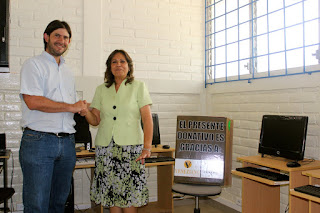
Santa Ana, ES - Who remembers saving files to a floppy disk? Personally, I recall labeling each different one with permanent marker, and getting strange stares in college when attempting to retrieve a paper from one in my university library. And that was six years ago.
For many students in El Salvador however, working with computers that still require them is a daily task.
As Emilio Lopez Diaz, owner of Cuatro M and Beneficio El Manzano, visited and toured Escuela de Educacion Especial "Elisa Alvarez de Diaz," a school in Santa Ana, El Salvador; technology was something he noticed, observing computers in the school’s media center that were purchased, practically speaking, before Facebook was invented.
Escuela de Educacion Especial, was established to provide educational services for students with special needs in the Santa Ana community. Named after his grandmother, and near the location of his coffee mill and roastery, Emilio Diaz considered it to be the perfect candidate for a profit sharing initiative he had begun at Beneficio El Manzano one year ago.
The initiative gives green coffee buyers and roasters the opportunity to purchase green coffee from Cuatro M at a premium, paying $0.05 more per pound, on the contracted guarantee that the money will be used to invest in the recognized needs of schools within the area of the coffee mill.
So far, Cuatro M has paired up with Coda Coffee Company of Denver, Atlas Coffee Importers of Seattle, and Finca Ayutepeque of Santa Ana, ES for an initiative at the Ayutepeque School, where they replaced all of the cafeteria cooking and kitchen supplies, in order to enable their staff to meet the needs of students. Also, Campos Coffee of Sydney, Australia has joined in the initiative to assist the El Manzano School in Las Cruces County.
Now, only days away from a celebration of the schools name, honoring the life of Elisa Alvarez de Diaz, who passed away two months ago; Emilio Lopez Diaz, on behalf of Cuatro M and Veneziano Caffe of Melbourne, Australia, was able to deliver three brand new computers to the principal and staff of Escuela de Educacion Especial, assembling and installing them Thursday morning in the school's media center.
"I want to replace them all,” was the first thing Emilio said as we climbed back into the truck, and waved back to the extended hands of staff and principal, recalling the wear and damage to the six or so computers still remaining.
Thanks to buyers and roasters like Veneziano Caffe however, and others who value more than just the coffee in El Salvador, Emilio Diaz and Cuatro M are confident we will.
There are a myriad of things that happen to a coffee, between the time it is harvested from the tree, to the moment it is brewed, cupped, and tasted; and even then, takes different courses depending on the type of cup. A universal experience, yet dynamic, delicate, and unique; sacred in its unrefined, natural essence and unabridged conversion.
Coffee is harvested from a tree, and if quality is considered, by hand. On the tree, coffee is called a cherry, or in spanish - uva, and is hand picked according to ripeness, leaving unripe beans for a later harvest. Cherries will then then be sorted, to distinguish the ripe beans from the incidental unripe, sticks, leaves, etc, and will then be bagged in burlap sacs and weighed. This weight is taken by the farmer, owner of the plantation, to determine the picker's days wages, typically one dollar per twenty five pounds of cherries, a measurement referred to as arroba.
If a farmer does not process his own cherries, they will be sold to an external processor, someone who buys the cherries from the farmer, and likely picks them up from their plantation. At Beneficio El Manzano, this happens four times a day, where trucks are sent out to collect the coffees purchased from the nineteen surrounding farms in Santa Ana, El Salvador; processing High Grown (HG) and Strictly High Grown (SHG) coffees from eight distinct growers.
(Coffee is a delicate crop, meaning that throughout its growth and processing, it will absorb the flavors of that which it comes into contact with. For example, it will absorb the flavors of other crops it shares the soil with, which many farmers will intentionally plant to give their coffee certain preferred taste or aroma.
Since it is picked as a fully ripened cherry, harvested coffee immediately and naturally begins to ferment. Most coffee will therefore be processed within 24 hours of being harvested, lest it develop sour, alcoholic flavors. Much of the processing method of coffee is geared to allow it time to do that very thing, however, leaving coffee in its natural fruit is a riskier processing method, considering the potential to ferment and thereby spoil the beans).
With picking occurring during the day, trucks begin to arrive the mill by nightfall, and thereby begin the first step in the processing method. At Beneficio El Manzano, this process is called the Weighing and Categorization Process.
The first part of this process is very simple. All trucks are scheduled for a delivery time, and upon arrival, with coffees bagged in the bed will drive onto a calibrated scale. The driver scans a bar code, which registers the information of the truck; the name of the farm it is coming from, the altitude of the plantation, the variety of coffee, the number of sacs, and pre-measured weight of the sacs.
While on the scale, the second step of the process begins, the categorization or grading of the cherries delivered. Since there are so many variables in the production of coffee, ie: altitude, fertilization, harvesting methods, a grading system was developed by Cuatro M, as a means of determining the quality of the cherries, in order to provide feedback to the farmer, determine which regional coffees can be blended with others, and determine the premium paid to the farmer for his cherries. Prices for cherries purchased each harvest is predetermined, however, this grade, determines the price offered to a farmer in the coming harvest.
The categorization process (grading system) works by taking one sample from the sacs of cherries delivered from each plantation. This small sample is taken from the sacs delivered at a ratio of 1/10; so, if 30 sacs are delivered, sample cherries are collected from three of those 30 sacs, which are then brought into our lab for examination.
Once collected, 200 grams of those cherries are measured out, and sorted into seven categories of ripeness; 1). Fully Ripe 2). Pink Under-ripe 3). Yellow Under-ripe 4). Overripe 5). Dry Pods 6). Sun burnt 7). Green - Fully Unripe. The weight is taken and recorded for each of the eight categories, to determine the percentage of each category within the sample.
Once determined, the sample is analyzed within a rubric, which considers the maximum and minimum percentages that the cherries must have in order to earn a grade of AA, A, B, or C category cherries. For example, as shown below, a AA coffee will contain no less than 90% of fully ripe cherries, with more than 0.3% green cherries. If either of those standards are not met, it moves to the next grade.
While later assessment of the categorization process, or method of scoring coffee cherries, is practiced as a preliminary means of controlling the quality of coffees processed. It helps the mill to identify which coffees were harvested at their peak ripeness, and therefore promotes consistency within production. This consistency offers insight into which coffees may be blended, enables producers and clients to predict the quality of the coffees, and offers a premium, and thereby incentive for farmers to harvest only the ripest coffees.
After the categorization of the coffees has taken place, the cherries are delivered to the mill, where they are emptied from their sacs, into a cement hopper, that will feed the de-pulping machinery.

Beneficio El Manzano is now receiving coffee cherries every day, and with that the patios are beginning to fill up with the many different batches of coffee that has been processed. Batch number eight was laid out on the patio last night, however, like the rest of the current coffees on the patio, is forced to wait out the rainy afternoons and evenings in the warehouse, before it can be spread back out onto the patios.
While only eight batches of coffee have been processed to date, one will notice a greater number of sectioned coffees on the patio, and their colors are different. Each batch of coffee received at the plantation is separated into four primary qualities, which explains why you will see a higher number of piles on the patio than number of batches processed at the mill; however, coffee will range in color for several reasons.
First, you are seeing different qualities of coffee. As coffee is processed, a series of machinery will distinguish the different qualities. On a patio, many of the different piles of coffee you see are from the same plantations, however, of different qualities, due to different levels of ripeness, and degrees of size.
Imagine picking two oranges from the same tree, one more ripe than the other, which still bears a shade of green. More than likely, they are going to have very different tastes, despite being the same fruit, and coming from the same tree. As coffee passes through the various pocessing machinery, the beans are sorted into its four levels of quality. Each level of quality bears a slightly different color, due to the degree to which the machines are able to remove the pulp from the beans, due to the levels of ripeness and size.
Secondly, coffee may differ in color based on the amount of time it has spent on the patio. Imagine a Northern Michigander sprawled out on an open patio, under a constant sun. After a few days, you'd start to notice color changes. Same idea, except that coffee is not being burnt while on the patio.
Coffee is laid out in the sun completely wet, with a near one hundred percent moisture content. Over the next five to eight days, that moisture will be drawn out, forcing the beans to undergo a major chemical change, which as they remain on the patio, begins to change the color of their parchment.
The third reason coffee will vary in color, is due to the different types of processing it undergoes, after being harvested. Coffee cherries can be 1). Fully Washed - which means, after being de-pulped (having its outer fruit removed) it will spend several hours in a fermentation tank, in order to separate the bean from its mucilage; 2). Machine Washed - which means, that the cherry is de-pulped, but bypasses the fermentation tanks, and has its mucilage removed by a machine, using water; 3). Pulp Natural - the coffee cherry is de-pulped, but is dried without removing the mucilage; 4). Natural - where the coffee cherries only pass through a tank of water to determine the two main degrees of quality of cherry, but are then spread out on the patio to dry, without removing the pulp.
Beneficio El Manzano is capable of processing its coffee by each of the four methods, and depending on the method used, will determine the color it gives off on the patio, the fully and machine washed bearing a shade of tan or brown, while the natural coffees remain the red color, as it remains in its cherry on the patio.
If you happened to ask that question regarding the coffees you see in these photos, it is primarily because of the first reason I mentioned. All of these coffees, batches three through eight were processed with the Machine Washed method, and range in color solely because of the different qualities of coffee that are separated by the processing machines.
Santa Ana, ES - Who remembers saving files to a floppy disk? Personally, I recall labeling each different one with permanent marker, and getting strange stares in college when attempting to retrieve a paper from one in my university library.And that was six years ago.
For many students in El Salvador however, working with computers that still require them is a daily task.
As Emilio Lopez Diaz, owner of Cuatro M and Beneficio El Manzano, visited and toured Escuela de Educacion Especial "Elisa Alvarez de Diaz," a school in Santa Ana, El Salvador; technology was something he noticed, observing computers in the school’s media center that were purchased, practically speaking, before Facebook was invented.
Escuela de Educacion Especial, was established to provide educational services for students with special needs in the Santa Ana community. Named after his grandmother, and near the location of his coffee mill and roastery, Emilio Diaz considered it to be the perfect candidate for a profit sharing initiative he had begun at Beneficio El Manzano one year ago.
The initiative gives green coffee buyers and roasters the opportunity to purchase green coffee from Cuatro M at a premium, paying $0.05 more per pound, on the contracted guarantee that the money will be used to invest in the recognized needs of schools within the area of the coffee mill.
So far, Cuatro M has paired up with Coda Coffee Company of Denver, Atlas Coffee Importers of Seattle, and Finca Ayutepeque of Santa Ana, ES for an initiative at the Ayutepeque School, where they replaced all of the cafeteria cooking and kitchen supplies, in order to enable their staff to meet the needs of students. Also,Campos Coffee of Sydney, Australia has joined in the initiative to assist the El Manzano School in Las Cruces County.
Now, only days away from a celebration of the schools name, honoring the life of Elisa Alvarez de Diaz, who passed away two months ago; Emilio Lopez Diaz, on behalf of Cuatro M and Veneziano Caffe of Melbourne, Australia, was able to deliver three brand new computers to the principal and staff of Escuela de Educacion Especial, assembling and installing them Thursday morning in the school's media center.
"I want to replace them all,” was the first thing Emilio said as we climbed back into the truck, and waved back to the extended hands of staff and principal, recalling the wear and damage to the six or so computers still remaining.
Thanks to buyers and roasters like Veneziano Caffe however, and others who value more than just the coffee in El Salvador, Emilio Diaz and Cuatro M are confident we will.

The new mechanical dryer has arrived at the plantation, and after sitting at port for a hectic week, rests disassembled, scattered about the plantation, awaiting the completion of its covering at the new patios, for installation.
After being harvested, all coffee, whether de-pulped and washed or natural, must be dried to an internal moisture level of twelve to twelve and a half percent before it can be bagged and roasted. For this step in processing, beans, as parchment or cherries, are spread out onto patios.
Although ranging according to country, patios in El Salvador typically contain clay or cement tile. Beneficio El Manzano houses cement tiles, with a total area of approximately 48,500 square feet, in addition to the 20,000 tiles being laid presently, handling 1.1 million pounds of green exportable coffee in 2010-2011.
All of the coffee processed here will remain on the patios a minimum of two days; until its internal moisture level has dropped to less than 40%, at which point some will remain on the patios another three to five days, until reaching twelve to twelve and a half percent, while the rest will be put into mechanical dryers to complete that process.
The mechanical dryers currently used at the mill are vertical cylindrical dryers, and were constructed in the 1970's. In these types of dyers, coffee is cycled every hour from the bottom to the top of the cylinder via bucket elevators, where it passes through streams of hot air contained at the bottom of the dryer, ranging from 125 to 135 degrees Fahrenheit. The heat for the dryers is produced by furnaces burning coffee husk.
The new dryer that will be installed, is a horizontal cylindrical dryer, pictured above, which allows heat, produced by furnaces, to enter through a central shaft, and releases it through a rotating perforated cylinder, where the coffee is being circulated. Unlike the vertical dryers, heat passes through the entire cylinder, meaning the coffee is channeled, but dried without pause, thus reducing both the time needed for the coffee within the dryers and the amount of husk consumed by the furnaces.
We hope to have the dryer installed by the middle of the month; but for time being, it remains an intriguing myriad of mechanical import shrapnel for wandering photographers.
Helpful information gathered from: http://www.coffee-ota.org/cd_hygiene/cnt/cnt_en/sec_3/docs_3.2/Intro%20coffee%20drying.pdf
The new mechanical dryer has arrived at the plantation, and after sitting at port for a hectic week, rests disassembled, scattered about the plantation, awaiting the completion of its covering at the new patios, for installation.After being harvested, all coffee, whether de-pulped and washed or natural, must be dried to an internal moisture level of twelve to twelve and a half percent before it can be bagged and roasted. For this step in processing, beans, as parchment or cherries, are spread out onto patios.
Although ranging according to country, patios in El Salvador typically contain clay or cement tile. Beneficio El Manzano houses cement tiles, with a total area of approximately 48,500 square feet, in addition to the 20,000 tiles being laid presently, handling 1.1 million pounds of green exportable coffee in 2010-2011.
All of the coffee processed here will remain on the patios a minimum of two days; until its internal moisture level has dropped to less than 40%, at which point some will remain on the patios another three to five days, until reaching twelve to twelve and a half percent, while the rest will be put into mechanical dryers to complete that process.
The mechanical dryers currently used at the mill are vertical cylindrical dryers, and were constructed in the 1970's. In these types of dyers, coffee is cycled every hour from the bottom to the top of the cylinder via bucket elevators, where it passes through streams of hot air contained at the bottom of the dryer, ranging from 125 to 135 degrees Fahrenheit. The heat for the dryers is produced by furnaces burning coffee husk.
The new dryer that will be installed, is a horizontal cylindrical dryer, pictured above, which allows heat, produced by furnaces, to enter through a central shaft, and releases it through a rotating perforated cylinder, where the coffee is being circulated. Unlike the vertical dryers, heat passes through the entire cylinder, meaning the coffee is channeled, but dried without pause, thus reducing both the time needed for the coffee within the dryers and the amount of husk consumed by the furnaces.
We hope to have the dryer installed by the middle of the month; but for time being, it remains an intriguing myriad of mechanical import shrapnel for wandering photographers.
Helpful information gathered from: http://www.coffee-ota.org/cd_hygiene/cnt/cnt_en/sec_3/docs_3.2/Intro%20coffee%20drying.pdf

The 2011-2012 coffee harvest has officially begun at Beneficio El Manzano, in Santa Ana, El Salvador; receiving its first two batches of bourbon cherries on the twelfth of September from farms: Finca El Manzano and Ayutepeque.
After processing and drying, the pergamino, or parchment coffee, is bagged in burlap and transferred to the bodega, or warehouse, for thirty days to await hulling, the process of removing the parchment, or dry pulp, from the beans. (Complete details of theMilling Process at Beneficio El Manzano).
Then, this past thursday, Eduardo, from quality control, or the lab side of the company, hulled and roasted samples of both batches for Cuatro M's first cupping of the season, performed by himself and three of us others, including Emilio, the owner.
While evident of the early harvest, the cupping was, in itself, ceremonial of beginnings, for Cuatro M, of a promising new season that will certainly surpass those before in quantity and always expectantly in quality.
