The Ethiopian Commodity Exchange (ECX) was established with an ambitious goal of eliminating food shortages and hunger in Ethiopia by creating an efficient marketing system for agricultural commodities. Barely two months after its launch, the highly praised exchange platform found itself caught in the midst of the complex global coffee trade, an undertaking that is entirely different and farther from its original vision of "revolutionizing" the inefficient domestic commodity market.In August 2008, the government enacted a new law that forces the trading of all of the country's coffees through ECX and ECX welcomed the decision. Since then, the government confiscated stocks of coffee from exporters and revoked licenses, filled in the vacuum with the Ethiopian Grain Trade Enterprise (EGTE), and sold Specialty coffees at commodity grade coffee prices.Following its first rough encounter, ECX is now engaged in talks with Specialty coffee buyers and faced with challenges of wining the hearts and minds of traders locally. But, the effect of ECX on coffee growers is yet to be noticed. This piece attempts to reveal the pitfalls of trading coffee through ECX and its impact on small-scale farmers.Learning coffee on the flyAs it has now become apparent, ECX was not ready to accommodate trading operations of a complex global commodity when it embarked on coffee export. This partly explains why ECX has had to run into problems as soon as it started its coffee trade.ECX was initially established to create a trading platform for domestic agricultural commodities, mainly grain. The ECX was created with primary purposes of eliminating the archaic marketing system whose inefficiency, according to ECX's founder, Eleni Gebre-Medhin, are in part responsible for the recurring food shortages and hunger in parts of Ethiopia, and increasing the value of the domestic grain. Dr. Eleni described her vision in June 2007 at TED Talk as:"Ethiopia's domestic market is about $1 billion of value and we feel over the next five years, if Ethiopia can capture even 40%, just 40% of the domestic market and add jut 25% value to that market, the value of the market doubles. ECX, moreover, can become a trading platform for the Pan-African market in agricultural commodity. Ethiopia's agricultural market is 30% higher than South Africa's grain production; and, in fact, Ethiopia is the second largest maize producer in Africa."This ambition is founded on plausible assumptions about domestic grain trade but it did not take into consideration the state of coffee trade. Because the market system was designed to bring about changes in the grains trade – not in the coffee sector – ECX ended up further complicating the problems facing coffee growers when it suddenly decided to take on coffee trade.Mandatory exchangeBy requiring 100% of coffee trade be conducted through ECX, the government eliminated direct trades. The government says that was necessary in order to improve the sector and prices. This is frivolous.Unlike grains, coffee trade is characterized by unregulated supply, market monopoly by a few multinationals companies, and stiff competitions among producing countries. Coffee is a global commodity. It is the world’s second most traded commodity next to oil with its prices determined at the New York exchange market. The trade is largely controlled by the world's biggest coffee buyers. Five multinational companies, Nestlé, Philip Morris, Procter and Gamble, Sara Lee, and Kraft Foods buy about 70% of the world’s coffee and play pivotal roles in setting world coffee prices. Coffee growing nations do not have a say in this unregulated global market.To mitigate the burden, other coffee growing countries are resorting to creating differentiations and to find a place in the Specialty niche market. The direct trade relationship with Specialty coffee buyers gives these nations a relative stability, premium prices, and incentives to increasing quality standards.ECX, on the other hand, adopted a strategy of forced bulk trading through a warehouse receipt system and eliminated direct trade. Still, it hopes to improve prices and the sector.Underestimating Specialty coffeeThe global coffee industry is increasingly moving towards greater transparency of coffee origins and differentiation but the ECX system is heading in the opposite direction. Ethiopia is naturally endowed with the variety of coffees demanded by the Specialty coffee buyers. The fine quality of its coffees and the distinctive features of the sector, including its genetic resources, abundance of wild coffee trees, and the organic coffee production, earned Ethiopia a unique place in the global coffee marketplace. Ironically, instead of capitalizing on these unique attributes, ECX aims at bundling all of the coffees into commodity grades.One possible explanation for this absurd strategy is ECX's underestimation of the importance of Specialty grade coffees. “The “specialty-plus” market segment is only 3.7% of the total coffees exported, with the remainder to be considered as commodity coffee," says ECX in its whitepaper titled What is in a Bean?This unsubstantiated analysis has led ECX to a mistaken conclusion, thus its decision to neglect the Specialty market and focus on aggregate coffee production. ECX's estimation is flawed and can be proved wrong by the following cursory appraisal of empirical evidences.In 2008, Starbucks, the world's largest Specialty coffee buyer, bought 192,500 tons of Specialty coffee, of which 5-10% (the company’s official numbers always fall within this range) was directly sourced from East Africa. (The major coffee growers in East Africa are Ethiopia, Kenya, Tanzania, and Rwanda.) Since Ethiopia is the largest exporter of Specialty coffee in Africa, and, given Starbucks' long history of close relationship with coffee growers in the country, it is reasonable to assume around 3% of Starbucks' purchase (or about 60% of its East African purchase) comes from Ethiopia. Meaning, around 5,775 tons of Starbucks’ 2008 purchases is practically from Ethiopia. Since Ethiopia’s export during that year was 170,888 tons, Starbucks’ purchase only represents 3.4% of Ethiopia’s export.So, if at least 3.4% of Ethiopia's Specialty grade was directly sold to Starbucks, one can imagine how the number can easily jump to a range of upper teens to twenties when the quantity that Starbucks bought through Germany (Starbucks buys most of its coffee from Germany which is also one of Ethiopia's major export markets) and the coffees directly sold to other small buyers through direct trade.It is thus extraordinary that ECX diminishes the roles of Specialty coffee in Ethiopia. Furthermore, it is unbelievable that ECX failed to see the fact that Specialty coffees drive the global coffee trade.Marketing experts agree that the prestigious coffees such as Sidama, Yirgacheffe, and Harar serve marketers as ingredient brands. The prominent Oxford Professor Douglas Holt defines ingredient brands as: “brands that are used as one component “ingredient” of another branded product or service. Gore waterproof fabric and Intel computer chips are classic examples."Dr. Holt argues, “Consumers view the ingredient’s inclusion as a distinctive and valuable addition to the offer. The ingredient is revealed to end-consumers through some sort of distinctive mark (name, logo, etc.) so that the inclusion of the ingredient increases the perceived value of the offering."By undermining the roles played by Specialty coffees to promote the sale of Ethiopia's aggregate coffee export, ECX's bulk trading system poses a threat to commoditizing some of the distinct coffees in the world. Farmers that grow some these finest beans expect their produce to fetch them a price better than that of the run-of-the-mill beans. The lack of incentive for their hard work may have adverse effect on the country's Specialty coffee production. As quality deteriorates, the country’s prestigious brands water down as well.Unfair competitionWhen responding to criticisms about its position on direct trade, ECX cites as an example the cooperatives and commercial farms that are directly selling Specialty coffee outside of the ECX system. This is true but the problem is, by allowing selected group of growers to have access to the Specialty market, ECX leaves out the smallholder families that are not organized in cooperatives. This practice deprives farmers of the privilege of establishing business relationship with external buyers.In addition, the current ECX system also subjects small-scale farmers to a potential market monopoly by a few exporters. Farmers are not represented in the ECX Board of Directors, a body that currently comprises three major coffee exporters, including Berhane Hailu, General Manager of EGTE, and seven government officials. This degree of power imbalance puts farmers at a disadvantage.Coffee trade under current ECX system is far from being a level playing field. It is difficult to imagine a marketplace that is fair to farmers in a setting where the government owned enterprise, EGTE, working to maximize profit and ensure uninterrupted inflow of foreign exchange also directs ECX. As far as small-scale coffee growers are concerned, ECX has so far not been “fair, independent, and free.”If ECX were to be of any benefit to the poor farmers, it should create an environment where the bulk trading system functions alongside a direct trading system for Specialty coffees and other certifications such as Bird Friendly, forest, and organic coffees. This is a lifeline for many smallholder farmers and that is where they have comparative advantage over competitors.
Read more…
Posted by Matt Milletto on September 2, 2008 at 11:41am
Woohoo! We now have our 1st Podcast available! I am very excited to start doing these podcasts every month or two, and will be inviting guests who have insight on the specialty coffee industry from a baristas perspective and more.
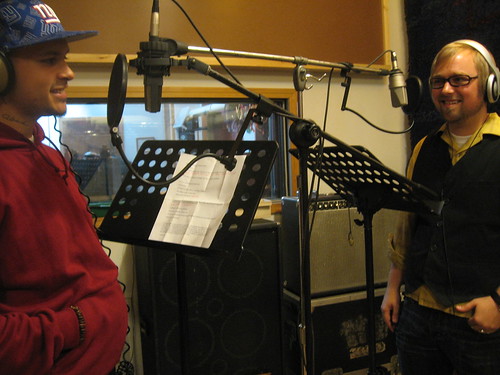
This first Podcast features Christopher Nicely Abel Alameda who works at Vivace in Seattle, WA. Christopher went on a week long Barista Exchange to Puerto Rico to work at "Barista Espresso Bar" owned by Enid Guerra, fellow bXer who recently opened her shop after attending the American Barista & Coffee School. We also discuss the Millrock Latte Art Competition coming up at Coffee Fest in a couple weeks.
Podcast is 15 minutes. Click here to listen to it in full.
Thanks!
- Matt
Read more…
online community sites are funny.... every one attracts some sort of crowd and if its around long enough you can catch the trends.... the cool profiles vs the really lame ones...Something I noticed while browsing through friends, and friends of friends, is, like myspace with the angles and high contrast, there are a few particular styles of photos people like to keep in their albums on bexchange...of course there is the latte art (*guilty*)then the ones sipping on a mug of coffee... some opt for the paper cup photo with the logo of the shop they work at...other photos are ones behind the bar holding a portafilterand so on..... I'm sure you can, if not already, notice what I'm talking about....not necessarily pointing this out in negativity, it just makes me laugh......thats all ^__^
Read more…
A message to all members of Barista Exchange!
I wanted to let you know that we are rolling out a new release to the bX network this Thursday, June 5, from 9 to 9:15 p.m. bX will be offline during this brief window.
There are a number of features in this release, including:
1) Forum Improvements. In addition to a redesigned forum, you will now have the option to choose between two styles of threads: "Flat," where replies are shown in chronological order, or "Threaded," where replies are indented below the post or the reply that they respond to.
2) Allow members to customize their My Page layout. Members will now be able to drag-and-drop modules around their profile pages. This will allow you as a member to fully customized what you want on your My Page.
3) Enhanced Widget Distribution. Members can easily spread Barista Exchange badges, widgets, individual videos and photo album slideshows to MySpace, Facebook and 15 other popular destinations without the need to copy and paste HTML embed code.
Thanks for your patience I am hoping the site will only be down for 15 minutes.
- Matt
Read more…
It has been a while but we did another Bellissimo Podcast yesterday, and Bruce decided to do it on ... drum roll ... Barista Exchange :)
After you listen to the PF.net podcast, feel free to check it out, it's 20 minutes on bX and what I have planned for the future ... Click here to listen to the Bellissimo Podcast.
Enjoy!
- Matt
Read more…
Happy to see that BaristaExchange.com has been featured in Imbibe Magazine's "uncorked" section in their Mar/Apr Issue. If you havn't already checked out Imbibe, it's a great addition to everyones beverage magazine subscriptions also including Barista Magazine and Fresh Cup.
Imbibe is the magazine of liquid culture. It is a completely new way of looking at drinks—as a distinct culinary category, deserving in-depth exploration of history, ingredients, preparation, artistry and consumption. From wine, spirits and beer to coffee, tea and everything in between, Imbibe celebrates the world in a glass.
- Matt
Posted by Matt Milletto on April 24, 2008 at 10:48am
Hello baristas! My friend and past ABC School graduate has a very successful coffee business in Puerto Rico. She is opening her second coffee bar and is looking for a barista to come and spend 3 days or so on site with her and her staff. Here is the email she sent to me in regards to the exchange. Feel free to email her for more info, could be a really fun experience.
- Matt
Here is a picture of Enid (far right) and her staff:
Hi Matt:
This is Enid Guerra from Puerto Rico. I took the Barista training couple years ago. I hope you remember me. I have a tiny but beautiful EspressoBar. In May we will have two years in the business. One of the best decisions was to take the course with you in Portland. I fell in love with coffee and I am living the dream. We have the best coffee in Puerto Rico. (you will have to believe me unless you want to stop by...). I am opening my second store soon.
I know José Arreola since I am a National Judge for the WBC for the second year in a row. He is by far the most charismatic person I have ever met. The first WBC Judge Training was conducted in my Bar. One of my Baristas was third in the National Competition (this year). Another of my female Baristas was fourth. It was their first year competing so I was happy with the results. I am also highly involved with the Puerto Rico Barista Association.
The reason I am writing is to know if you know a Barista that would like to spend three days in Puerto Rico. We are looking for someone that would like to come and spend part of the day in the bar with my Baristas so they could experience people with their same passion and dedication. There are not too many Baristas in Puerto Rico and honestly my Baristas sometimes feel they are alone. You know, I am the boss, it is not the same.
In terms of payment we can agree in some type of payment. I am honestly looking at this as an exchange instead of a job.
We can provide transportation and we can pay a nice Hotel. Also we will pay for all the meals and can agree in extra cash for personal expenses. We can also visit some of the best coffee "haciendas" in the island.
Please let me know if you know someone that could be interested.
Best regards,
Enid
787-349-4561
email: baristaespressobar at onelinkpr.netRead more…
We are proud to announce the next Barista Exchange Meet Up will take place Friday, April 11th in conjunction with the NERBC. The party is sponsored by the American Barista & Coffee School
Here are the details:
Friday, April 11th, 2008
8pm - 1am
Ithaca, NY
The Chanticleer Loft (corner of Cayuga St. and State St.)
Barista Exchange members will receive their official Barista Exchange Member buttons, if you don't already have one. Come rock out with baristas and coffee fanatics. For more info you can message Erin McCarthy.
Read more…
Posted by Andy Newbom on February 13, 2008 at 4:38pm
February is the month of coffee and love with Valentines day and Specialty Coffee month sharing the stage. And that coffee love is blooming at Silicon valley's Barefoot Coffee Roasters. Barefoot is hosting Guatemalan National Barista Champion Noe Castro for the month of February. Noe Castro was the Guatemala national Barista champion and went on the compete in the 2006 World Barista Championships in Tokyo nabbing 28th place. Noe recently took third place at the 2007 Guatemala Barista Championship and won the title of “Best Espresso” at the championships.For the months of February and March Noe will be participating in a Barista Exchange at Barefoot Coffee Roasters. Noe will be exchanging information, techniques, coffee passion and stories with the Barefoot Coffee team. This is a unique arrangement that builds great rapport between all of the participants. The high end of the specialty coffee industry is a supportive community that thrives on open communication and co-opetition. Noe will be learning to roast coffee, cup and blend coffees from many different countries and learn new espresso extraction techniques. In exchange Noe will be helping to train Barefoot's Barista competition team, Monica Hill and Marie Holston, as they prepare for the Western Regional Barista Competition March 29-31st 2008 in Berkeley, CA. Noe will also be working the espresso bar pulling espressos for customers throughout the month at Barefoot's coffee bar.“My passion is coffee. ” Said Noe Castro Cacao. “Working with Barefoot Coffee is a remarkable opportunity for me to advance my coffee knowledge, skill and passion. The level of coffee preparation knowledge in the United States will allow me to achieve my goal of representing Guatemala in the World Barista Championships in 2009.”And to continue the spirit of the exchange he will also be spending a week or two at Ritual Roasters in San Francisco doing many of the same educational opportunities. This type of open community and exchange is a hallmark of the artisan coffee industry where relationships and results are more important than brand.Artisan roasters take great pride in hand crafting coffees of the highest magnitude. The multi-layered flavor complexities exceed that of even the finest wines. And many of these roasters take the coffee so seriously that they develop direct relationships with coffee farmers in producing countries to ensure the highest quality and most unique flavors. These relationships also serve to pass more of the profits to the coffee farmers themselves through education and awareness.“ Noe is an amazing Barista and representative of Guatemala Coffee. “ Mused Andy Newbom, Chief Espresso Officer of Barefoot Coffee Roasters, Inc. “We are honored to be able to host a true champion of great coffee. We met Noe Castro on a trip to visit farms in Guatemala in February 2007, while we were training a group of Guatemalan Baristas and we offered to help Noe refine his presentation for the World competition. His passion, dedication, charm and humility are backed up by his exemplary skill in making great coffee. Damn! This is gonna be a fun month!”“ In Guatemala most Baristas have little or no contact with coffee roasters.” explained Edwin Martinez, owner of Guatemalan coffee estate Finca Vista Hermosa in Huehuetenango. “For Noe to work directly with an artisan coffee roaster of the level of Barefoot Coffee and to learn roasting, blending and cupping is a huge opportunity for him.”
Read more…