All Posts (50)

Sort by
SCAA has announced a membership mixer and Latte Art Showcase Saturday, October 4, 2008, 5:00 pm - 7:00 pm at:Tiara Cafe127 E Ninth St.Los Angeles, CA 90015http://www.tiara-cafe.comRSVP to Mansi Chokshi at(562) 624-4100 or email to mansi at SCAA .orgMembership mixer will feature a Latte Art showcase, hosted by event sponsor, Coffee Bean & Tea Leaf. Everyone is invited.For more information regarding this event and other upcoming events, visit the SCAA website at http://www.scaa.org.
Read more…

Vancouver, BC. Part 1

Tradegy.The beginning of last Augest, some co-workers and I decided to take a trip up to Vancouver to tour the Coffee industry, hang out, and do Canada things. Its rough that things don't always work out how you want...We left Seattle around 7:00 PM Friday night. Five of us packed into a two door Subaru. The sense of togetherness was great...a little too much. We arrived at the boarder around 9:15ish. We love national security and things of that nature. After searching the car for a little over an hour, we restart our journy and realize that much to our dismay, they re-organized most of the car! And, in the process, took Alex's keys. We still haven't found them.The next day we started our adventures off at Cafe Artigiano on Hornby, home of the mythical 5 GROUPHEAD LINEA! The coffee was decent, and we were all impressed that for the hour that we lingered there, there was a constant line 13 people deep! Way to go, guys!From there we headed off to Brad Ford's Wicked Cafe. We got some juicy shots of Black Cat pulled by the manager, Arthur. We sat in the rain. We talked with Brad and Arthur about their new cafe on Hornby, which should be opening soon! If your in Vancouver, check it out. These guys know what their doing, not to mention have great tattoos.We lunched at a Persian deli on Commercial, and continued our search at Re-Entry Cafe. We were greated with Espresso Vivaces Vita blend. Your never too far from home, I guess.From here we visited 49ths Cafe on Fourth. O dear...O dear. Imagine walking into a cafe designed by the coolest people in the world. And then synchronize all the colour with blue and brown. Then be served Epic off a hot Mistral(that apparently has cut everyone on staff at least once, don't know how I know that...). And also imagine you have a million dollars. That makes it a little more fun. Here we met Conrad, the V-neck loving barista who rang us up and put on old time country music. We like Conrad. We Love Conrad, actully. Conrad has a sweet Soma(I think...), 48x17. He told us to hit up Elysian room right around the corner, so we did...The Elysian Room is Coffee-God Alistair Durie's brain child. Located in a smallish storefront location next to a rug store(?), movie theatre, and BMW dealership(who was having a bar-b-que...), The Elysian Room offers some tastey 49th Parallel coffees in a chill-ass enviroment. Think single orgin Brazil pulled into a brown FAC's that tatstes like coffee cake melted into a cup. Wow. Also, think lime green Synesso.Wow...To sum up the evening, we watched some wackey firework compatition and then got jumped. Nothing to major.After a recovery/good nights sleep at the Grand Trunk Hostel, we rolled our wagons out to Origins Roasters on Granville Island. This is the remenace of Hines Public Market Cafe in Seattle, including an all-star line up of John Sanders and freinds. We cupped some awsome coffees roasted on their old-ass probat, and played around with inovative new gadgets, like the auto adjusting doser. And we got some sweet pins to take home. I totally dig the pins.That night we dined with my hero and man crush, Mark Prince. We snuck some bottles of Punt E Mes up for Mark, and in turn, he took us out for sushi. Barrent and Coltair(?) Jones came along, and the evening was as good as you could picture it. Mark and I had a heart to heart about stretching. This is one thing I never, ever, ever thought I would do.The next day we visited the 49th roastery in Burnaby. We cupped a few Ethiopians, a Kenya, and the Colombia La Planada with Lindsy and Vince. Sammy showed me around the Renegade roasers(5 kilo and 60 kilo). Beautiful machines. I FINALLY figured out what Agtrons are actully doing. We watched Coltairs compatiton routine, and sampled his drinks. They absolutley sucked. Just kidding. He is on fire. Keep it up, Coltair(?)!On the way home we hit up Edwin at Onyx in Bellingham. Edwin is amazing. He is setting up an awsome cupping/training facility with killer ideas. We talked for hours. Unfortunatly, I had to close that night, so we made a mad dash back for Seattle where we ended our journey.In Conclusion:check out the-Elysian Room-49th Parallel-Wicked-Mink ChocolateWe learned:don't-get jumped-pull knives on drunk guys who want to hurt you-back into a corner and let them surround you and your freinds-let them hit your co-workersI guess it wasn't too much of a tradegy...Stay tuned for Chapter 2, The Return.Expect our car to get broken into and Marks Punt E Mes to get stolen, along with hundreds of rare Japaneese psycidalia and Spanish disco CD's!!-Matt
Read more…

I have stuff to sell

I have come into owner ship of several cases of Dr. Smoothe brand smoothe mix, i have the following flavorsTropical ParadisePear peach apricotLime O RitaForbidden FruitGrape BananaI'm selling this by the bottle at 10.00 USd a bottle.
Read more…

Man Challenge

Oh my 'lanta.So the baristas here at Hardbacks are a bunch of goofs. We have so much fun with one another its ridiculous.We have blender battles to see who can make a better smoothie faster (i cheat and click off their blenders lol)We play the letter game (A to Z of whatever; animals, cities just random crap like that)The best thing so far was when i was challenged to our favorite game. Plainly called "Categories". Simple.So Amanda comes up and yells out "styles of ladies underwear". I asked her what the loser had to do. We ended up making a sewer sludge that the loser had to drink. What's pathetic is that i won and she had to drink that shit. GAG!!!But the real she got me back about an hour later. I was raggin on her about how i (A man) knew more about ladies underwear than she :)She finally just got fed up with it and shouted "MAN CHALLENGE!!!".....of course now that she said that i had to accept or be called a pussy for the rest of the day.So she brewed up a double shot....and then let it sit for about a minute..... then she told me to drink it.So i slammed that shit and wow.... EWWW!!! i just gagged and laughed with everyone.Good times.Until Next Time....( Slipshot )
Read more…

How do you forget the coffee!!!!

Okay, so we just opened the new Hardback Cafe not even a week ago and so far it's going smoothly. We've had a fairly steady flow of customers and our beginning and "intermediate" baristas (including myself) are doing pretty damn good.During our training a while ago (i assume this is the same with any coffee shop) we've gotten pretty close to one another already....except for like one person.There is one barista that is just bugging the shit out of everyone ALREADY! (let's remember, VERY new cafe, VERY new staff. Open 1 week.)He makes good coffee most of the time, but he doesn't wash his dishes, he stands around instead of helping the other barista with their drinks and he is sssslllllllooooooooooowwwwww!!!!!The biggest problem i have with him so far, and this will change, is that he doesn't follow our cafe's specific coffee recipe process. He thinks he can brew like he did at Starbucks........ WTF man. Do we look like a fuckin 'Bucks? We have different beans, different powders, different syrups, different sauces, and let's not forget.... DIFFERENT MACHINES.We have our own way of doing things just like any other coffee shop. Break away from what you think you know and adapt, man. Golly Gee. :)So, i got to the cafe (as a customer) and they were short as help. I'm just coming in to chill and have a brew before job #2 starts, but i ended up helping anyway cuz i like the cafe to go smoothly....and i LOVE BEING A BARISTA. This kid thinks he knows everything. He handles customers well, but chats a little too long for the most part. So when they finally got another barista in to work i ordered a very simple drink to make (especially considering we have super automatic Frankes). So tell me if any of you would have trouble making this:Breve white chocolate, Rasberry Mocha. Double shot. Ristretto.I was pretty excited about this drink. lol, It's pretty yummy from our place....when made properly.My boss comes in for some scheduling stuff so we sit down and start to chit chat, joke around, that kinda thing. I took a drink of my seemingly delicious coffee...... It tastes like piss water! DECEPTION!!! lolI could not even sense a hint of espresso in that friggin cup. So i assumed this guy forgot my shots. So then i assumed he didn't know how to make a decent steamer, let alone a cup of coffee. I was pissed!!! How do you forget the coffee! Lame....My boss was not impressed. Neither was i.Even though i may sound like i'm bitching an moaning about something as miniscule as this, i hope you don't take it like that. I actually find this to be quite hilarious. And you should too. I bet this happens all the friggin time to all of you.Please feel free to share some of your stories. I'm always looking for conversational fodder.Until Next Time....- The Best of Brews to you all -( Slipshot )
Read more…

Amateur mistakes

I have been playing with my cotton filter and hand grinder for , approximately, 1.5 years. At first, things went well, lovely aftertaste, aroma and etc. Then suddenly one day all the good things disappeared. Yeah in one single day!I thought it was the beans so I talked to my roaster whether the sudden change is related to the beans or not. For sure the beans were fine because some casual cuppings were done and the cups were absolutely tasty.We then came to a conclusion that it could be 1) water temp which I kept constant, 2)grind which I kept constant, 3) brew time which I thought it's okay. I played with water temp for quite a long time since I had the experience of getting strange coffee because of wrong temperatures. Alright, I get overextracted and underextracted cups and it seemed that there were no intermediate cup profiles!One day, I heard my roaster saying that for cotton filter, the grind should be 1notch finer than what I had been using. I adjusted the coarseness and I got some slightly stronger cups but they were nowhere close to what I had at first. I keep trying and trying for maybe 9 months or, perhaps, 1 year (doh!) .If you can withstand the boredom of this post and have not closed your browser, you might say, ' Hey dumbhead, you never checked your brewing time!'Indeed, I never measured the time precisely and it was not too long ago that I knew 0.5g of grounds can have serious effects on the final cup. Last week I decided to measure it seriously with a stopwatch and I was absolutely shocked. I always thought that the brewing time was pretty much okay, i.e. 3mins 160ml . Heck no! It took 2mins only to finish one brew, which is WAY TOO FAST. I then use the finest adjustment on my hand grinder and it took 2min 20 sec. Nope, not ideal and the cup sucked.I reluctantly put my hands on my super jolly to grind much finer. I never used SJ for filter coffee since I hope to use a 'cooler' grinding method so more aromas can be preserved. I managed to get a 3min brew after 2 or 3 trials and the cup was pretty good. Although there are more things to experiment but at least now I know why all different parameter changes never worked! The grinder is already too old and cannot do the job well. That means I need to buy one more hand grinder.Lesson learned: Check parameters precisely, counting in heart is way too stupid.Yes, filter coffee is less demanding than espresso, but it doesn't mean you can do it casuallyHappy Brewing!P.S: I hope my grammar is not too broken :P
Read more…

Peanut Butter Bliss Latte Recipe; Peanut Butter Latte

Peanut Butter Bliss Latte Recipe; Peanut Butter Latte2 shots illy Espresso3/4 oz Monin Flavoring Syrup; Peanut Butter1/2 oz Monin Caramel SauceSteamed MilkAdd espresso, Monin Peanut Butter and Monin Caramel Sauce to cup and stir well.Fill with steamed milk.Top with whipped cream and a drizzle of Monin Caramel Sauce
Read more…

Coffee Nudge Recipe a la Torani Coffee Syrups

Coffee Nudge a la ToraniIngredients:1/2 oz. (1 Tbsp.) Torani Creme de Cacao syrup1/4 oz. (1 1/2 tsp.) Torani Coffee Flavoring syrup1/4 oz. (1 1/2 tsp.) Torani Mandarin Orange syrup3/4 cup brewed Torrefazione coffeeTorani flavored whipped cream, for toppingInstructions:Combine ingredients in a footed coffee glass. Stir gently. Top with Torani Creme de Cacao flavored Whipped Cream and dust with nutmeg. Serving/Yield: 1-12oz.
Read more…

Pumpkin Spice Latte Recipe; Jack-O'-Latte Recipe

Pumpkin Spice Latte Recipe2 Shots Espresso - hot from your espresso machines1/14 oz Pumpkin Spice Flavoring Syrup: Monin Flavored Coffee SyrupsSteamed MilkAdd espresso and Monin Pumpkin Spice to cup and stir well.Fill with steamed milk.Top with whipped cream and dust with pumpkin spice or nutmeg
Read more…

Caramel Apple Latte Recipe2 Shots illy Espresso1 1/4 oz. Monin Flavoring Syrup; Monin Caramell Apple Flavoring SyrupSteamed MilkAdd espresso and Monin Caramel Apple to cup and stir well.Fill with steamed milk.Top with whipped cream and a drizzle of Monin Caramel SauceIf Monin Caramel Apple is not available, proportionatly combine Monin Apple and Monin Caramel syrups for substituion
Read more…

Ethiopia Sidamo...

New Single Origin Coffee available! Ethiopian Sidamo, a washed coffee with some really nice if not slightly out of the norm character.Most striking is it's similarity to a late harvest dessert white wine. Refreshing and sweet green grape flavors in a nicely powdered sugar in honey texture. Slightly percieved grape peel as well. The finish reminds me of a nice dry chablis. Roasted to keep the sweetness prominant and the acid light and in balance with the sugary texture. Unusually low acid for a washed sidamo, but very pleasing. The texture adds nicely to the medium body as well.
Read more…

victrola cupping

finca vista hermosai think only the second time i've had it, actually, but that is a mistake to be corrected. lots of milk chocolate, totally reminiscent of my hometown huehue.production yirgclassic earl grey, with a discernible and nice tartness on the finisha couple of earthy sidamo samplesboth of these had a lot of plainly obvious variation in bean size, and the lack of cleanliness was discernable in the cup. which is, you know, kind of how it goes. i am by no means a natural hater, but they were a bit musty.a costa ricanum, uh... i forgot. sorry. i'm out of practice.2 el salvador samples (one peaberry)both were bright and lemony, but the non-peaberry was particularly good as it combined that with some chocolate notes resulting in a more balanced profile. a well balanced combination of lemon zest and dark chocolate, which i'm not sure conveys what i'm trying to say very well, but it was rad. hopefully they'll be able to put it into production.and something else i'm forgetting.it was really cool to have some pre-production samples on the table. reminds me of the halcyon portland days when i was an annex rat and jim would do mid-day QC cuppings he was gracious enough to let me in on, on occasion.thanks to perry for running the show and sarah jane for pulling me a killer deuce of streamline afterwards.
Read more…

CK Staff Presents in Nicaragua

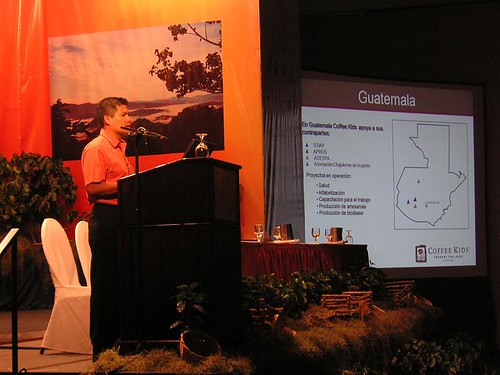
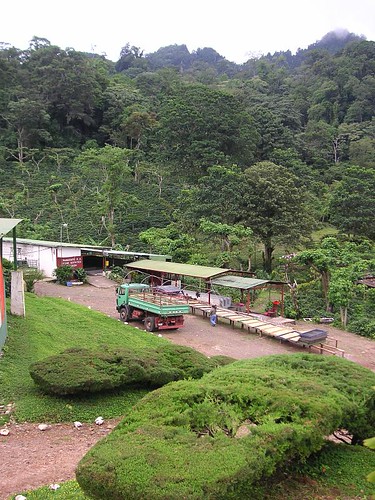
From September 1-4, 2008, Coffee Kids’ program staff attended Ramacafé 2008 in Manauga, Nicaragua. More than 300 participants from 16 countries (mostly from Central America) attended the event.Coffee Kids presents at RamacafeSince 2004, Ramacafé has gathered scholars, producers, roasters, specialists, cooperatives and organizations involved in the coffee industry and coffee culture to share and discuss the future of the industry. This year, José Luis Zárate, Coffee Kids’ international program director, was invited to participate in an education panel on the first day of conference.During the session, José Luis Zárate stressed the importance of community-based projects that respond to the needs of people in coffee-growing regions. Zárate’s presentation gave Coffee Kids’ staff the opportunity to meet various cooperatives and organizations from Central America that are interested in helping coffee-farming families.Finca La VirgenThe first day of the conference featured topics such as coffee certification, production and commercialization, as well as the health benefits of coffee, sustainability and education.Zárate and International Program Coordinator José Carlos Leónalso visited Finca La Virgen, a coffee plantation in the state of Matagalpa, Nicaragua. During the visit, Zárate and León saw a clinic constructed by the finca that provides free medical care and medicine for the employees of La Virgen and people in the nearby communities. The finca has also constructed a school for local children and an eco-hostel to capitalize on the popularity of point-of-origin tours.
Read more…

Barista Champ Champions Coffee Farmers

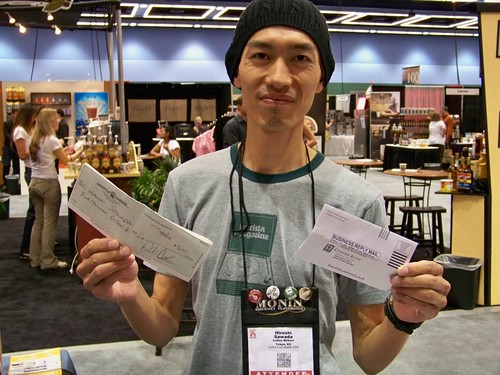
What a great way start a Monday. When I arrived last Monday, I had a message of good news and glad tidings from Sarah Allen at Barista Magazine.Hiroshi Sawada This past weekend (Sept. 12-14) Hiroshi Sawada, owner of Caffe Milk Art in Japan, competed in the Millrock Latte Art Championship and took first prize in one of the most challenging competitions to date, besting 39 of the best latte artists in the world. He has competed in numerous barista competitions traveling around the world to display his craft, but this is the first time he won. Sawada was awarded a check for $5,000 for his efforts.Following the award ceremony Sawada tracked down Sarah Allen and said that he wanted to donate all of his prize money to Coffee Kids. All of us at Coffee Kids are humbled by Hiroshi's generosity and grateful for his help in improving the lives of coffee-farming families.Congratulations on your win, Hiroshi and thank you!The competition was presented by Barista Magazine, Nuova Simonelli and Dillanos Coffee.
Read more…

How 2 Make Money In The Coffee Industry

I figured, I would write my thoughts on making money in the coffee industry. I have worked for several coffee shops, I have also worked my own coffee concession. I roast beans by pan, yes it's work, but it's also fulfilling, however the question is am I making money? Well honestly I would have to say no, why because although I work for myself I'm glued to the bean, and with that I can't go out and enjoy the coffee scene the way I would like to. Now knowing what I want to do, it's a matter of doing it, I feel now that in order to make money, I'm gonna have to network more, I believe that if I can connect with just 2 like minded individuals we could take over the entire coffee scene, yeah like Starbucks did, I want to see just how long it takes me to make what I consider money in the coffee industry. Right now I have the freedom, just not the money to travel and coffee the way I like.It is my belief that in a year I should be able to travel as I wish, if I apply myself.I market my products to individuals as well companies, anyone with info or leads on how I should go about being more effective, my business depends on word of mouth.Any and all words of wisdom appreciated.Until next time here, I'm your BaristOnDutY.
Read more…

Bad news

I recently had my hopes for joining in a barista competition dashed. In talking things over with the owner of the shop I work at, I've come to realize that I will have to either do some major fund-raising/sponsor-begging, or sit out yet another year. And due to the energy that the former will require, I'm leaning towards sitting out.I'm not happy about giving that up, but with my life going in so many directions at once, I am content to keep my coffee world as calm as possible for right now.With that being said, I know I am still going to attend Coffee Fest Chicago this year, and I am going to try to work it out to get to the 'Spro down in Chi' Town. So at least I still have a few things to look forward to.On another note: I had a co-worker laugh at me for using the slang term "Spro" the other day. He had never heard such a thing, and it seemed quite funny to him - and he actaully said he didn't like it! To each their own I guess. I use that term and a few other coffee slang terms when I am talking to co-workers and customers and I've never had someone mention a distaste for them...at least not to my face. Anyway, just a bit of randomness for ya.Cherie
Read more…

Night Music; the sounds of coffee and West Java.

23_gunung%20salak%20merdeka%20coffee.gif

Jakarta is a city of noise, a cacophony of noise. From the moment you arrive in the city, whether it is by airplane, train or bus, the new arrival steps into a warm, humid bath of sound. The noise is mostly man made, motorbikes, trucks, cars, horns, sirens, bells. It is a place not for those who like peace and quiet.Rural Indonesia is quite the opposite- a mixture of man made and nature’s sounds gently rolled into a smooth, round packet.West Java is normally not known for its coffee cultivation. Back in the early Dutch Colonial days, most of the original coffee was planted in a wedge shaped curve that stretched from Batavia up into the hill country around Bogor and Sukabumi. The coffee was grown here mixed with Pepper and Clove trees. The more valuable spices, Nutmeg, cinnamon and nuts such as cashew were traded from the islands further to the east through the Port of Batavia (Jakarta), then back to Europe on company ships.Coffee initially grew very well on the flat land around Batavia. Today the areas where the coffee was planted are densely populated inner city suburbs- there is no sign of the small private plantations that once thrived there. Likewise the rolling hill country that rises from the city towards Bogor has little sign of the past agricultural endeavours. As recently as world war 2, Dutch plantations stretched along the banks of the Cileungsi River, and up into the hills behind modern day Bukit Sentul and Cibinong. The Cileungsi River was a pleasant waterway used to transport Coffee, fruit, Cloves, Pepper and rubber grown in orderly plots down into Jakarta for local consumption and export.Today the toll road runs through to Bogor, 45 minutes south of the Capital City. Along the way the most obviously greenery is the golf courses of Emeralda, Riverside and Bogor Raya. The remnants of the plantations surprisingly can still be found. Driving through Cibinong towards Jonggol the hills are still farmed; rubber trees and cloves planted decades ago healthy and bearing latex and fruit. However it is much more difficult to identify where the original coffee plantations were.As in many growing countries, the truth is the coffee is still there, if you know where to look for it. Over the years I have either stumbled upon remnants of the original coffee plantations, or been invited to view coffee that has been unearthed growing wild- tall and straggly, amongst new growth of secondary rainforest.Sukabumi is a city southwest of Bogor. The geographic area that covers Sukabumi down to the Indian ocean port town of Pelabhuan Ratu (Queens Harbour) was at one time settled heavily by Dutch settlers. The clubs at Pelabhuan Ratu are mentioned in great detail by writers as late as the 1920’s and 1930’s as being busy havens for planters and their families when coming to town on market days. Again it is difficult to believe today, but a detour up onto the slopes of Gunung Salak or the hills surrounding the harbour confirms the continuing existence of the prime plantation crops, including coffee.In the late 1890’s and early 1900’s, rust played havoc with the Arabica coffee plantings throughout the Dutch East Indies. Much of the coffee was wiped out and replanted in first Liberica, then Robusta. Robusta remains the main type of coffee grown today, despite efforts to try and focus growers on the more difficult to cultivate, but higher returning Arabica.Around West Java Robusta is common, Arabica less so. Arabica stands are often remnants of the original plantings- by DNA testing can be pretty accurately traced back to either Malabar or Ceylon Arabica root stock. These were the types of coffee that the Dutch brought into Batavia and planted early on. Modern Arabica plantings also exist, becoming more common around Bandung and even as far North as the Bandung rise of Puncak Pass.At this time of year the coffee growing areas are an extremely pleasant place to spend a night or two. It is the monsoon season, and in mountainous West Java that means heavy, turbulent afternoon thunderstorms. The original stands of coffee are often mixed in with newer plants of robusta and the staples of Papaya, Banana and Pandan. Vanilla is also often grown at the higher altitudes. Around 3 in the afternoon, the wind drops and the air thickens like the atmosphere in a Botanical garden Glasshouse. The chatter of birds, crickets and even the bleating of goats lessens, in expectation of what’s to come. When the rain arrives it is preceded by distant thunderclaps, and the sizzle of lightening stretching across the hazy blue sky, occasionally reaching down to a ridge or reaching tree-top. The first drops are heavy and bloated, literally splattering on the soil and Banana leaves. The coffee trees, growing beneath the taller canopy, are initially well sheltered fro the rain, but soon everything- including chickens, children and coffee are wet through.The wind slowly picks up, pushing the rain from a heavy vertical fall, to a cutting horizontal path. Clay tracks turn to mud and any villager unfortunate enough to have been caught out in the Sawah/Padi or on a motorbike, is soaked to the skin. The coffee trees stir in the wind, seemingly enjoying the moisture, the deluge.The end of the storms often coincides with dusk, the period of the day when activity ebbs toward evening, and night music. The remnants of the rainfall drip melodically from the tall trees, through the coffee trees below onto the ground. Chickens root for grubs that have been drawn to the surface. Children emerge from beneath red terracotta tile roofs to play in the puddles.The music is taken up to a new level, like an orchestra tuning their instruments, when the local mosques begin calling the villagers to Sholat Magrib. Every village has at least 1 mosque, so as the evening falls the voices of the many imam blend and rise together, in balance. Magically the sky begins to turn a fiery orange, flecked with gold and red amongst the remaining wisps of thunder cloud. Only Tropical evenings embody the colours, sounds and smells such as these. The slight fragrance of sweet jasmine from coffee blooms, tinged with the smoky sweetness of charcoal grilled chicken sate. The murmur of an evening breeze that touches the higher slopes of the valleys above the villages and the rising chatter of the evening masters of gentle, natural noise- the Cicadas, crickets, cicak and geckos.It is hard to believe that many of these villages are a mere hour or so from the more braise and metallic noise that is Jakarta or Bandung. An evening amongst the coffee growers of West Java is a trip back in time to a much simpler and perhaps wholesome era.© Alun H.G Evans, 2007. All rights reserved. May be republished on permission and/or if author is given full creative recognition in writing.
Read more…

Roasting around IKE

This has been a tough time for everyone, Gas lines, Grocery Lines, no coffee, what no coffee, well here at Hopson Coffee we were prepared and roasted 100 pounds on Sunday after the storm. I have several generators, (I sell them with electrical services with my other full time business), so we fired up the roaster and made brown beans. I was really well prepared for this as my family had a 100lbs of beans and rice, along with a stocked walk in pantry, plenty of water, even a well we can drink from. Long story short prepare for the worst, hope for the best, and I hope everyone is doing wellBill Giffen
Read more…
Local “Coffee Cultures” and the Global Coffee MarketJoe MarinoIllinois State University2008-Abstract-The tastes and preferences of coffee consumers in the United States affect the livelihoods of coffee producers in places such as Central America, East Africa, and Southeast Asia. In this paper I examine the attempts of a coffee shop owner in Central Illinois to create a “coffee culture” in which his clientele learn to appreciate the different qualities of coffee and make an educated choice with their coffee purchases. The global coffee market is currently being characterized as a "coffee paradox" (Daviron and Ponte 2005). As the popularity of coffee as a beverage is on the rise in large consumer nations such as the US and various European countries, the price per cup is also on the rise. Meanwhile, as coffee producers elsewhere in the world are trying to keep up with the brewing popularity, the price of their crop is falling. Although it is high quality—or "specialty" coffee—that is in demand, majority of the coffee that is on the market today is of low quality and is produced cheaply in mass quantities. Measures have been taken in the form of international regulatory policies set by the International Coffee Commission, as well as by social movements such as the "ethical consumption" movement (Levi and Linton 2003). Using data collected from participant-observation at the coffee shop in Central Illinois and ethnographic interviews with the owner, employees and clientele, this study examines consumers’ coffee preferences and their knowledge of coffee production. As part of a larger study on trends in coffee production in Central America, this paper makes a contribution to anthropological studies of the effects of a global economy on local systems of production and consumption.It is a typical weekday morning at Kaldi's Kup, a small specialty coffee shop in central Illinois. It's just past 9 o'clock and the crowd of regulars starts to shuffle in carrying the look of fatigue on their faces, still tired from yesterday's long hours spent behind a desk settling students' tuition accounts, grading papers, or studying for exams. I am a barista at Kaldi's Kup, and every morning I brew the finest specialty coffees from around the world, situate the homemade pastries in the bakery case, and adjust the espresso grind to make sure that every shot that I pull possesses each of the subtle complexities characteristic of our award-winning blend. However, most or our customers are not too concerned with these subtleties, just as long as their lattes and cappuccinos are as delicious and topped with beautiful latte art as they were the day before.Gabriel, on the other hand, is a different type of customer. He is an administrator of the university just down the street from Kaldi's Kup, and comes into the shop two to three times a day, always with the same order—"a double espresso, please." This is the type of customer that Kaldi, the owner, loves to please, not necessarily because Gabriel drinks espresso, but because he is rich in coffee knowledge. He knows exactly what he wants, knows how it is made, knows how it should taste, and he knows exactly where to get it.On this particular morning, as I see Gabriel walk in and stand in line at the register, I begin to check my grind. I pull shots of espresso into two ounce shot glasses to check the volume, then taste them to check for body, crema, acidity, and the elusive hint of cocoa. As the order comes in over the computer screen on top of the La Marzocco espresso bar, I pour hot water into a demitasse to warm it up, and start the grinder. After the shots have been pulled to their full capacity, which takes about 25 seconds, Gabriel approaches the counter with a smile as he hears the ring of the little spoon being dropped onto the saucer. As he walks away with his two ounces of diffused elixir, he admires the dark brown flecking, or "leopard spots" as he calls them. He pushes the spoon back and forth along the caramel-tan crema and pulls it out to taste for bitterness. Meanwhile, I stand behind the counter watching him intently through the small space between the hopper and the bar, searching for an expression of approval. He takes the initial sip, blinks his eyes and smacks his lips. He takes another, and again quickly smacks his lips while taking in short breathes—"oohh," he says in a low voice, "that's good."Global commodity chain studies in anthropology explore the exchange of capital over great distances to expose relations between groups of people in different localities around the world. The purpose of this study is to explore one end of the coffee commodity chain, specifically the cultural practices of coffee retailers and consumers, to gain an understanding of how such practices affect, and are affected by, other aspects of the global coffee market. Through the lens of political economy, I analyze ethnographic data from a locally-owned specialty coffee shop in central Illinois, where customers—like Gabriel—acquire a coffee knowledge base while cultivating their tastes and preferences for specialty coffee. These cultivated tastes and preferences then create a demand for the coffees that they enjoy on a daily basis. However, the majority of what is learned by customers pertains to the taste characteristics of coffee, very little pertains its production—much less the social, political, and economic aspects of the global coffee market. While a true commodity chain analysis would require a multi-sited ethnography, this project seeks to understand how retailers and consumers—both agents of the consumer society—envision their role in the commodity chain.POLITICAL ECONOMY AND COMMODITY CHAIN ANALYSESThe concept of political economy came about as eighteenth-century theorists reflected on the strong economic core of nation-states and their relations with their colonies on the periphery. The term “political economy” comes from Jean Jacques Rousseau in his 1755 work A Discourse on Political Economy (Ericson and Murphy 2003) in which he addressed the legitimate power of the State to govern in the interest of the common good of the nation. The idea of a political economy proposes that the State has power over the economic system of the nation so as to control the wealth of the nation and those under its power (Ericson and Murphy 2003).In the nineteenth century, social theorists Karl Marx and Frederick Engels studied the phenomena of the expansion of Western capitalism and the seemingly exploitative relationship between nation-states and their capital-producing colonies. They postulated that the unequal distribution of wealth is the product of a capitalist world-system that created an economic pole between the colonies and the powerful Western nation-states (Ericson and Murphy 2003).In the twentieth century, researchers such as André Gundar Frank (1966) and Immanuel Wallerstein (1974) began to reexamine the effects of global capitalism, which was supposed to have modernized underdeveloped countries and brought an influx of capital through the process of industrialization. Frank and Wallerstein postulated that instead of giving countries in the New World the ability to modernize and produce capital, the exploitative nature of global capitalism is actually keeping these former colonies underdeveloped (Wallerstein 1974).Frank (1966) conceptualized the relationships between "developed" and "underdeveloped" nations in what is known today as the global economy. Frank reexamined the effects of global capitalism, which was supposed to have modernized nations and brought an influx of capital through the process of industrialization. However, Frank criticized the idea held by modernization theorists that nations are solely responsible for their own economic development and he claimed that the developed nations are in fact keeping underdeveloped nations in a state of dependency.Researchers inspired by Frank and Wallerstein have looked at the world in terms of the interrelatedness, interconnectedness, and interdependency of societies as a result of the long history of global capitalism. Anthropologist Eric Wolf (1997) argued that anthropologists' traditional focus on studying a single culture, nation, or culture area would not lead to a full understanding of the modern world. Taking a historical, global systems approach he focused on how small, so-called “traditional,” societies had been incorporated into the global world-system and had responded. Using the Marxist approach of Frank and Wallerstein, Wolf further examined how and why some cohorts of people have adapted their cultural understandings to capitalism, and prospered as a result of doing so, while others had not. Wolf’s theory of political economy describes two realities existing in the world: 1.) “the reality of the natural world and its human transformations by technics and organization” and 2.) “the reality of schemata of organized knowledge and symbolic operations learned and communicated among human beings” (Wolf 1997: xiv). Other scholars taking this approach to connecting the material reality of culture with the interpretive reality of culture include Sidney Mintz (1985) and William Roseberry (1989).More recent anthropological research taking a political economic approach shows how the world system of global capitalism affects the lives of those in societies of primary production and societies of primary consumption. In commodity chain analyses, commodities are followed from producing nations to consuming nations and—in between these two, very often distant locations—processes such as value placement are analyzed to view the affects on each location. Many case studies of commodity chains have cited the fact that the desires and practices of consumers in the North affect the livelihoods of producers in the South (Fischer and Benson 2006, Daviron and Ponte 2005, Collins 2000).For instance, in Tracing Social Relations in Commodity Chains: The Case of Grapes in Brazil (2000), Jane Collins shows how the taste preferences of Europeans directly affected the livelihoods of small Brazilian grape farms. A year-round demand for grapes makes it necessary for European countries to import much of their produce from the southern hemisphere. These demands require the grapes to be of a certain quality, which puts pressure on small farmers in Brazil to consistently produce high-quality grapes. Small farms account for one-third of the total grape production, while the other two-thirds come from larger agribusiness firms. The smaller farms are able to produce higher quality grapes due to close family management which allows them to be more efficient and cost effective. However, they face disadvantages in exporting their product because they are only able to produce a fraction of the larger agribusiness firms, and thus are unable to afford the means of refrigeration and transportation. Their smaller income and smaller profile in the industry also puts them at a disadvantage with establishing close relations with foreign markets.The commodity chain of coffee can be thought of as a linear process—moving from its place of production (or origin) to its place of consumption. Coffee is grown around the globe in nations that are considered to be underdeveloped or developing. On the other hand, coffee is predominantly consumed in developed, or "core" (Frank 1966) nations, such as the US and most of Europe, and is one of the largest and most important commodities in the world (International Coffee Organization). The global coffee commodity chain is a process that connects millions of people in different parts of the world. Although producers and consumers are disconnected by thousands of miles, they are reconnected by the socio-cultural practices affecting consumption and production.In The Coffee Paradox, Benoit Daviron and Stefano Ponte (2005) make a contribution to the theories of political economy and, in particular, attempt to bring clarity to the fact that producing nations of coffee—the second largest agricultural commodity behind cotton—are still very poor and underdeveloped in relation to the US and European nations. Daviron and Ponte pay particular attention to the consumption of coffee in the US and Italy and focus on the value of coffee. They make distinctions between three types of value: 1) material qualities, 2) symbolic qualities, and 3) in-person service qualities. The authors claim that while the producers of coffee have some power in the material sense, much of the symbolic and in-person service aspects of value are controlled on the consumer side of the chain. As the popularity of coffee as a beverage is on the rise in large consumer nations such as the US and various European countries, the price per cup is also on the rise. Meanwhile, as coffee producers elsewhere in the world are trying to keep up with the brewing popularity, the price of their crop is falling. This market crash, which started in June of 1997, is known today as the "coffee crisis" (Osorio 2002). The coffee crisis is the result of international market deregulations and the changing taste preferences of consumers. As prices were on the rise in consuming nations, the profits fell into the hands of intermediary agents of the global coffee commodity chain, such as importers, roasters, and retailers [see the schematic of the commodity chain below (Talbot 2004)]. Most affected by the "global coffee crisis" (Osorio: 2002) were small-scale coffee producers in developing countries, which count on coffee exports as a major source of their national revenue.[Source:Talbot 2004: 32]The political economic history of the coffee commodity chain is filled with market crashes and market booms, policy implementations and policy failures, all of which have had subsequent effects on the economic health of coffee producing nations, not to mention the livelihoods of the coffee farmers themselves. Ongoing economic research shows the rise and fall of the coffee market each year. There is much more to economics than just the statistics behind supply and demand. What is not so ubiquitous is research that shows the human involvement in this global commodity. After all, as Wolf (1997) points out, it is through socio-cultural interactions that such processes as supply and demand become real.Both consumers and producers are often blind to the effects of capital exchange on the social relations that surround the commodification of labor. Yet, coffee consumers in Central Illinois have an effect on the livelihoods of coffee producers in underdeveloped countries. For this particular study, however, the question of whether the United States, as a consuming nation, keeps coffee producing nations in a state of underdevelopment will be set aside. Instead I will be investigating the discourse of coffee in a small consumer setting to elucidate the role of this particular commodity in the lives of consumers on this side of the commodity chain in the global economy.Consumers as individuals, and a consumer society as a whole, are key components in a global commodity chain. In this context, much responsibility is placed upon consumers, whether they know it or not. In Contradictions of Consumption, Tim Edwards discusses the concepts of consumption and the practices of consumers that make up their daily lives. In distinguishing between a "consumer culture" and a "consumer society," Edwards describes "consumer practices as matters of style, taste, and identity," as pertaining to consumer culture, whereas "the more [political], historical or economic underpinnings of consumer practices" would be characteristic of a consumer society (Edwards 2000:3). These conceptions of consumerism present a useful lens with which I may be able to analyze and theorize the coffee consumers in central Illinois and the discourse of coffee on this end of the global commodity chain. The taste preferences and purchasing habits of these local consumers will have an affect on the livelihoods of producers elsewhere, thus it is important to analyze how these choices are made on a daily basis. Coffee consumers that frequent a small coffee shop in Central Illinois are presented with a choice of coffees from different coffee producing nations. The choices they make on a daily basis will have an affect on the livelihoods of producers elsewhere. But how do they make these choices? What factors come into play when deciding which delightfully aromatic beverage to enjoy on that particular day? How do they, or are they able to make the choice to come to this particular shop—as opposed to other coffee shops located within a short distance?Using data collected from participant-observation at the coffee shop in Central Illinois and ethnographic interviews with the owner, employees and clientele, this study examines consumers’ coffee preferences and their knowledge of coffee production. However, before turning to these data, I provide a brief history and overview of the global coffee market.COFFEE IN THE GLOBAL ECONOMYThe Legend of the BeanA young goatherd by the name of Kaldi was guiding his goats through the 6th c. hills of Abyssinia—what is known today as Ethiopia. As a musician and poet, Kaldi took to the pleasure of playing pipe and singing songs while he let the goats wander. When it was time to go home, he would play a distinctive note and the goats would come running to his side. One day, he played the familiar note, but the goats didn't come. A little worried, he went to look for his goats and heard them bleating in the distance. When he finally found them in a field of glistening plants with big red cherries, he stood puzzled as they were excitedly dancing about. He thought for sure that his goats had gone mad! He was finally able to get them home, but the next day, the goats immediately took off for the same field off in the distance. When Kaldi caught up to them, he found them eating the leaves and cherries of the mysterious plants as they pranced around in a fuss. Curious, the boy tried a cherry from one of the branches and began to dance around with his heard in utter joy. [Adapted from Pendergrast 1999]History of Coffee in the Global EconomyAlthough coffee was most likely discovered in Abyssinia—or what is known today as Ethiopia—the first major producer and exporter of coffee was Yemen. Sometime in the 6th century, the Abyssinians invaded Yemen, which is located just across the Red Sea, and subsequently brought with them seeds to cultivate in the area. In the 16th century the Ottoman Turks invaded Yemen, and upon discovering the delight of their warm, dark, and stimulating beverage, distributed the drink throughout the Ottoman empire. By the 17th century, Europeans visiting Constantinople participated in what Mark Pendergrast calls "an elaborate social ritual,"[C]offee was brought to a boil three times in the ibrik (a small conical copper pot with a long handle) before the viscous drink was dispensed into small cups, the pourer carefully shaking his hand so that a little wesh, or froth, topped each cup. (Pendergrast 1999:7)Realizing the astounding popularity of coffee, and with the intention of monopolizing all of its financial benefits, the Turks forbade the export of any fertile cherry or bean that could be germinated and grown elsewhere. However, against their best efforts, a pilgrim to Mecca was successful in smuggling a couple of seeds to southern India, where he subsequently began to cultivate plants of his own. From India, the coffee plant spread to the Indonesian islands by the hands of the 17th century Dutch traders. They also brought coffee to northern Europe, where they grew plants in a greenhouse, then transported the offspring down to the more suitable climates of the Indies. As the Dutch were initiating the global network of coffee trade, they were also kind enough to spare a few plants to neighboring kingdoms, such as that of King Louis XIV. In 1723 a French naval officer by the name of Gabriel Mathieu de Clieu transported a plant from the Jardins des Plantes in Paris to the French colony Martinique.By the middle of the 19th century, coffee had spread all over the new world, with coffee farms springing up throughout Central America and on into South America. By the turn of the 20th century, Brazil was the world's leader in coffee production (Pendergrast 1999). In 1906 Brazil implemented a "valorization policy" (Daviron and Ponte 2005: 84) which formed strong marketing ties with the larger European and US merchant firms. This policy helped Brazil gain control of price-setting for Latin American coffees and perpetuated the growth of coffee farms elsewhere in the region.With the onset of the first world war, the 1929 market crash, and on through World War II, the coffee market was not only slowed by the inability of consumers to afford coffee, but was also fragmented along political lines. Prior to the Second World War the US was compelled to stimulate relations with their neighboring coffee producers to the south, and in 1940 the US and the Latin American coffee producing nations signed the Inter-American Coffee Agreement (Daviron and Ponte 2005: 86). As the European market had stopped buying Latin American coffee, and instead began investing in their own coffee producing colonies in Africa, the US had therefore become the largest importer of the Latin American crop. With the onset of the Second World War, however, the US had frozen its import prices, leaving the coffee producers holding nothing but their cherries. With the lull in exports, coffee was over produced and the prices were dropped. To ensure some stability in the market, most Latin American nations signed the Mexico Agreement in 1957, but it was not entirely sufficient for covering the global coffee market (Daviron and Ponte 2005). The first agreement to cover all coffee producing nations was the International Coffee Agreement (ICA), which was signed in 1962 under the International Coffee Council (ICC). This regulatory policy both set a minimum market price for coffee, as well as limited the exports of coffee for producing nations.A result of this "regulatory regime" (Daviron and Ponte 2005), was the mass production of the less costly Robusta varieties of coffee plants. These beans were widely used in the popular instant coffees and larger corporate coffee roasters such as Nestle and Philip Morris. The downfall of this stabilizing agreement, however, was influenced by the rise of the "Yuppie" culture (Pendergrast 1999) in the 1980s, which increased the demand for the more costly whole bean Arabica varieties. With the cold war coming to an end, the US no longer had to maintain such close ties to the Leftist Brazil or other Latin American countries that could have conceivably sided with the Soviet Union. Subsequently, this led consuming nations—especially the US—to deal with non-ICA members in pursuit of lower coffee prices. The failure to renew the ICA in 1989 left producing countries to struggle in the competitive market while maintaining economic stability. The price of coffee was cut in half from $1.34 per pound in 1988 to $0.77 per pound in 1994 (Daviron and Ponte 2005: 88).In this crash of the coffee market and subsequent "coffee crisis" (Daviron and Ponte 2005: xvii), producing nations lost significant amounts of capital and economic stability while intermediary agents of the coffee commodity chain in consuming countries benefited from significant profits. As larger, corporately tied producers try to keep their costs low by harvesting and planting inferior—but more disease-resistant—Robusta beans, smaller specialty coffee farmers invest in the more flavorful Arabica varieties to achieve a higher sense of quality. Although the popularity of higher quality beans among consumers continues to rise—as does the niche of small, privately owned coffee shops that feature such coffees—the small-scale producers are still unable to compete with these larger coffee producers. Growing attention to these vast inequalities and the demand for higher quality coffees in consuming nations has given rise to not only transnational organizations such as Fair Trade—which is determined to give fair compensation to farmers for the efforts in producing high quality crops.Specialty Coffee vs. the General MarketThere are two types of coffee beans most commonly used in the world today—Arabica (Coffea arabica) and Robusta (Coffea canephora). The varieties differ in size, flavor profile, and caffeine content. Robusta beans possess a much simpler flavor profile and thinner body in the cup than Arabica, and although they are smaller in size, they contain more caffeine. 70 percent of all coffee on the market today is of the Arabica variety. It is produced at high elevations in tropical and subtropical regions of the world, such as sub-Saharan Africa, Central and South America, and Indonesia. It requires anywhere from 1200mm to 1500mm of rainfall each year and an average temperature of 20 degrees Celsius (Talbot 2004: 31). Given that coffee is so ecologically specific and that it is one of the largest commodities on the market today, it behooves countries that are ecologically suited to grow coffee and treat it as the predominant source of national revenue. One would assume that the global popularity of coffee would yield high profits for those who produce the crop, yet these developing nations, on the "periphery" (Frank 1966), remain in poverty.According to the Specialty Coffee Association of America (SCAA), "specialty coffee" (SCAA 2008) comes from small-scale farmers who grow crops in exceptional climate conditions that allow the plants to develop to their full potential. Specialty coffees are made purely from Arabica beans, which tend to take on unique characteristics of the soil where the plants are produced. The distinct qualities of the soil in each particular region make it possible, then, for consumers to be able to enjoy various subtle differences in each cup of brewed coffee. When coffees are being tested and graded, specialists look for those distinct flavors and qualities characteristic of the region of origin. However, much effort needs to be made by the farmers in order to achieve the desired flavor profile. Although the specialty coffee sect makes up less than two percent of the global coffee market, over 25 million people are involved with its production.This specialized sector differs from the general coffee market—which is inundated with coffee that is not always grown in the proper conditions and is produced in mass quantities—in terms of production and marketing. Most of the coffee that is produced for, and sold in the general market is produced on expansive plantations in countries such as Brazil—the world's leader in coffee production. These larger plantations, or fazendas, have strong marketing ties with international import/export corporations that deal with larger marketing and retailing corporations in consumer nations. Production and harvesting on these plantations are described as "technified" processes (Talbot 2004: 199) as they incorporate the use of specified technologies and machinery. These machines are managed by technicians and laborers who possess the appropriate knowledge and training of how to use them. The purpose and focus in this type of production and harvest is truly quantity and not quality.Specialty coffee farms are located in the highlands of coffee producing countries and are usually family-owned. These small-scale farmers predominantly cultivate trees of the Arabica variety. It takes coffee trees approximately five years to mature, thus, newly planted trees will not yield fruit until after this happens. When they do begin to bare fruit, they bloom twice a year—once in the spring and once in the fall—whereupon they are harvested by the family who owns the farm with the frequent help of waged laborers. Among the various methods for harvesting coffee, the two that do not involve machines are: strip picking—which is common on farms such as the larger fazendas of Brazil, and selective picking—which is common on specialty farms (Intelligentsia Coffee Inc: Cultivation 2004). The strip picking method usually involves a group of workers whose goal is to make the least amount of passes along a row of trees while picking as many cherries as possible. Thus, the trees are stripped, branches at a time, without regard to the ripeness of the cherries. In contrast, selective picking involves multiple passes of each row by individuals carrying baskets. Pickers survey each plant carefully making sure to only harvest the cherries that are ripe, leaving the un-ripened ones to develop to their full capacity. This method is definitely more time consuming, since not only are the pickers going through the trees a branch at a time, they also have to make multiple passes along the same row of trees. The reason for this is because each tree yields only about one pound of beans per year. So in order to make sure every ripe cherry is picked, and there is a large enough quantity to sell, numerous passes must be made. The people that are doing this intense and time consuming work on specialty farms are usually the members of the family that owns the farm—children included. These families live in nations where 15% to 56% of the population is under the poverty line (CIA World Factbook: Vietnam, Guatemala 2008).Various transnational organizations have formed in the last ten years to address the issue of development, and with the mission of eradicating poverty in coffee producing nations. Organizations such as the Coffee Quality Institute (CQI), the International Coffee Organization (ICO), and the Specialty Coffee Association of America, all have a hand in working to create a sustainable coffee market by bringing producers closer to consumers. The SCAA and the Coffee Quality Institute work with the governments of both producing and consuming nations to set economic and environmental standards to ensure consistent high levels of quality. These organizations also take part in raising farmers' awareness of the flavor characteristics desired by the consumers. For example, the CQI has implemented a grading system for evaluating coffee quality:As a credible and independent service, the Q Coffee System helps to strengthen the supply chain for specialty coffee by creating a common language for quality, providing valuable feedback to producers, and a system to effectively identify and differentiate coffees.(Coffee Quality Institute: Q Coffee System 2005)With the absence of ICA regulations, which provided the security of a price floor, coffee producers had to think of new ways to make their crops distinct from the others on the market. Thus, many farmers, especially small farmers in ideal coffee producing climates, concentrated their efforts on producing coffee of the highest quality while employing sustainable methods to do so.Specialty coffees are made purely from Arabica beans, which tend to take on unique characteristics of the soil where the plants are produced. The distinct qualities of the soil—or terroir—in each particular region make it possible, then, for consumers to be able to enjoy various subtle differences in each cup of brewed coffee. When coffees are being tested and graded, specialists look for those distinct flavors and qualities characteristic of the region of origin. However, much effort needs to be made by the farmers in order to achieve the desired flavor profile.Boosting Prices: The International Coffee Agreement of 2007In 2007, the International Coffee Council (ICC) signed a new International Coffee Agreement (ICA), answering the cry of coffee producing nations in economic crisis. In the new agreement, the ICC recognizes the need for the market to be stabilized under the moral responsibility of both producing and consuming nations to create sustainability in the global economy of coffee. The discourse within the 2007 ICA revolves around this moral responsibility to bring producing nations—many of which "are largely dependent on this commodity for the export earnings and for the achievement of their social and economic development" (ICO: 2007 International Coffee Agreement)—out of poverty. Sustainable coffee production is thus a means of achieving the Millennium Development Goals developed by the United Nations in 2007 (United Nations 2005: UN Development Goals), which are to be achieved by the year 2015. The mission of the goal-set is to boost the livelihoods of all of the world's citizens by way of eradicating extreme poverty and hunger, improving environmental sustainability, and controlling disease.The following is an excerpt from the ICO website:The new Agreement is an important instrument for development cooperation and will provide the legal framework for core activities undertaken by the Organization in the future. Around 15 of the ICO’s 45 exporting Members are least-developed countries (with low incomes and high economic vulnerability), and the 25 million small coffee farmers and their families who produce 90% of the world’s coffee are particularly affected by fluctuations in market prices and imbalances in supply and demand. The Preamble specifically acknowledges the contribution of a sustainable coffee sector to the achievement of internationally agreed development goals, including the Millennium Development Goals, particularly with respect to poverty eradication.(International Coffee Organization: International Coffee Agreement 2007)As members of the ICA recognize the fact that the majority of the world's coffee producing nations are least-developed countries, they recognize the importance of international policies such as the International Coffee Agreement of 2007.KALDI'S KUPI want to create a coffee culture here [in central Illinois] where customers learn to appreciate the different characteristics of coffee and are able to make an educated choice with their purchases.–Kaldi 2007Kaldi's Kup is a small specialty coffee shop owned by Kaldi and his wife Abigail. They actually own two stores in town—one is located Downtown (and will thus be named), and the other Uptown—but for this study I have focused on the store located Uptown just down the street from a large university.Kaldi's first interest in the coffee business was not coffee itself. His primary motivation was finding a career that would allow for him and his wife to work together while raising a family. He knew that he wanted to go into business for himself because he didn't want to be at the mercy of someone else dictating his career. He is a self-admitted "perfectionist" and knew that whatever he got into he could do it right and do it well. He struggled with the idea of opening a café or diner, but was somewhat disenchanted with the restaurant business from past experiences. He knew that it would be very difficult open a restaurant with no "cash-flow," or no base income. He wanted to incorporate his baking abilities and knowledge into whatever he chose to do. He researched the internet for possible ideas and found that coffee is a perfect compliment to his baking abilities. As he tossed this idea around he saw a future for this particular venture in his home-town. He recognized that the specialty coffee market had not yet been tapped to its full potential in his community. As of 2002, there was not yet a Starbuck's in this community. In February of 2002 he made the final decision to go forth with his coffee shop idea, and in six short months, his doors were open for business. In that short time, he hired a consultant to help him design his shop and draw up business plans.My first experience in the shop was in early 2007. It gradually became my favorite hangout, as it is a great place to enjoy a good cup of coffee, study, or just kill some time between classes. By May of 2007, I had become very interested in the coffee industry and thought that I would apply for a position working at the shop. At the new employee orientation, Kaldi guided us through the process of cupping. This elaborate taste test could be likened to that of a wine tasting, where one would try small samples of wine—or in this case coffee—to become accustomed to the aromatic and taste characteristics of the drink. The ability to identify such characteristics allows the consumer to identify that which he or she likes in a wine or coffee.During the employee cupping, Kaldi stated that he wanted us employees to be able to describe the different characteristics of the coffees to the customers so that they may be able to tell the difference between a good cup of coffee and a bad one. To achieve his goal of creating a "coffee culture" Kaldi not only passes his coffee knowledge onto his clientele through his employees, but also through a weekly session of "coffee talk." Every week Kaldi will either perform a small customer cupping with the coffees we regularly carry in stock, or might feature a prize winning coffee—such as the 2006 Cup of Excellence award winner, Fazenda Santa Inés from Brazil. But not only is Kaldi concerned with taste, he is also concerned with selling a sustainable product.Sustainable Coffee: Fair Trade, Direct Trade, and OrganicFair Trade is part of the 'ethical consumption' movement; purchasing power is used to promote moral ends, goals that serve the material interests of others often at a cost (albeit sometimes relatively minor) to the consumer.–Margaret Levi and April Linton, Fair Trade: A Cup at a Time?Specialty coffee shops like Kaldi's are part of a movement that is focused on appealing to the moral responsibilities of consumers to make ethical choices when making their coffee purchases. As Kaldi follows and believes in the rhetoric of the ethical consumption movement, he only sells sustainable coffee. "The concept of sustainability in the realm of specialty coffee includes aspects variously referred to as 'economic viability for farmers', 'environmental conservation' and 'social responsibility'" (Daviron and Ponte 2005: 164). Most—but not all—sustainable coffee carries certifications such as Fair Trade or USDA Organic. However, Kaldi says that the Seattle roaster that he buys his coffee from will frequently pay four to five times over the market price for their coffee (which, in effect, boosts the price for each cup of coffee at Kaldi's shop). This Seattle roaster will often buy their supply of green coffee directly from the small farmers and leaders of coffee coops at origin. This process—called direct trade—is used by many small roasters in consuming countries to cut the middle links out of the commodity chain (i.e. state agencies, marketing boards, transnational importers). A representative from the roaster will travel to origin where he makes personal contact with the coffee producers and samples their crop in a series of tests. Throughout this testing process, the cupper, as he is called, will grade the coffee while looking for consistency in all of its physical qualities including: bean size, shape, and upon brewing, the aroma, acidity, and body. If the Seattle roaster is not able to make a purchase through direct trade, however, they will buy coffees that have Fair Trade or USDA Organic certifications.When customers come into Kaldi's Kup and place their order they are presented with a choice between two different brews indicated by their country of origin—"would you like Guatemala or Kenya?" It is at this juncture where the education for the consumer begins. The choice offered by the employee—or barista—is usually followed by, "well, what's the difference?" From there the barista will explain the different quality characteristics of the two coffees, describing the aroma, body, roast, etc. As the shop is frequented by many regulars, it is common for the customer to become accustomed to a particular origin. In the dialogue between the barista and the customer, the customer picks up on the different qualities of the coffee and is now able to identify that which he or she likes or doesn't particularly care for.Yet, although the coffee sold at Kaldi's Kup is rated in the top two percent for not only the quality of taste, but also their sustainable cultivation, the dialogue between customers and employees is usually limited to just the taste characteristics, leaving out whether or not the coffee is "Organic" (as approved by the United States Food and Drug Administration) or Fair Trade certified. Much less is the economic process of such certifications, nor the coffee market in general, discussed upon such an encounter. If Kaldi's goal of educating his clientele is carried out, how then do the customers orient to their roles as actors in the global process of coffee trade?Customers of Kaldi's KupIn the data collected for this study, I have identified three types of customers: 1) consumer as "king" (Edwards 2000: 11), 2) consumer as "anti-consumer" (Edwards 2000: 21), and 3) an indifferent consumer.As a consumer, Gabriel is king (Edwards 2000). He knows exactly what he likes and he knows exactly where to get it. In fact, Gabriel has so much power as a customer at Kaldi's Kup, that the baristas working at the shop gauge the quality of their espresso according to Gabriel's comments. Though, Gabriel went through a long process of coming to identify what he really wants in a coffee. After his first encounter with coffee in high school, he slowly got used to the taste of coffee while diluting it with a little bit of cream and sugar. After a while he was able to drink it black. Much to his surprise, he was able to pick up on the subtleties of each coffee. As he became more of a regular drinker, his tastes started to change from drinking the more flavorful light coffees, to the "stronger, bolder, French roasts." It wasn't until 2002, when he first visited Kaldi's shop, that Gabriel got a taste for what a good double espresso was. Of course, he had had double espressos before, but was never quite impressed with what he received. When he tried one at Kaldi's shop, he was both pleased and fascinated to find the complexities of flavors from just two ounces of the infused brown elixir. Every day he would come into the shop and engage in conversation with Kaldi or whoever the barista working the bar happened to be at that time. While sampling shots, Gabriel would talk with the barista about the different taste characteristics of the espresso, depending on the varying coarseness of the grind or blend composition.It soon became Gabriel's daily routine to come into the shop for discussion while savoring his morning boost of caffeine. Now he comes into the shop two to three times a day for a dose of "geek-talk" and caffeine. Gabriel claims that one demitasse will keep him going until after lunch, whereupon he will come into the shop to get another. He says that although he does feel a come-down from the caffeine, it is not as drastic for him as it was when he routinely drank regular drip coffee. However, since Gabriel recently bought a home espresso maker, he often makes himself his morning shot before leaving for work, then will come into the shop after lunch. Though, Kaldi need not worry about Gabriel's home espresso maker, simply because he buys the beans he uses to make espresso at home from Kaldi's Kup. Gabriel loves the blend used by Kaldi and claims that it is the "best blend in town."Gabriel's taste for coffee is much like his taste for wine—he loves a complex flavor profile, in fact, he says that this is the most valuable and important attribute of espresso. So it is fitting then, that he prefers blended wines, which, like coffee blends, possess such complexities. But where do these complexities come from? What is in the espresso blend at Kaldi's shop? Gabriel says that the "origins"—a term used to identify where the coffee was grown—that comprise the blend will determine whether he will buy it or not. Although he did not give a definite answer when I asked him what specific origins he looks for in a blend, he replied saying, "well, I know that Ethiopia will give it chocolate, Sumatra will be more earthy." Essentially Gabriel believes that if the blend contains specific origins like Ethiopia or Sumatra, then he knows that it will be good.These valuable taste characteristics, or material qualities (Daviron and Ponte 2005), identified by Gabriel, can be best explained through the concept of terroir, which is a term used by wine connoisseurs to describe the geo-specificity of particular wines. Wine growers in the French region of Bordeaux argue that blended wines can only be called Bordeaux if they come from the region of Bordeaux. As Bordeauxs are made up of a particular blend of grapes grown in the same region, they tend to possess a particular flavor profile that is characteristic of that region. Though, the types of grapes characteristic of a Bordeaux blend can of course be grown elsewhere in the world. However, the concept of terroir holds that it is more than just the type of grape that makes a wine special; it is the very soil in which the grape vines are cultivated that give the Bordeauxs their distinct flavor. The same argument is made by coffee growers in places such as Ethiopia—where a major trade marking movement is underway—that coffee also gets its distinct flavor characteristics from the soil in which the coffee plants are grown.Gabriel's particularity for taste, however, is in complete contrast to the indifferent customer who comes into the shop asking for a regular cup of coffee, and is somewhat confused by the choices presented to them. For example: a customer comes in and asks for a cup of coffee. The barista asks, "would you like Guatemala or Sumatra?" At this the indifferent customer says, "what's the difference?" The barista will then explain the different characteristics of each bean, only to have the customer say, "it doesn't matter, just give me a cup of coffee." However, it does matter to Gabriel, and not only does taste matter, but so does sustainability—to a point.Gabriel says that he loves to see blends that are Organic, "but," he says, "of course it would depend on the blend." If there are two bags comprised of the same origins sitting on the shelf at a store, and one was Organic and the other not, then of course he would buy the Organic blend. Yet, if the Organic blend was made up of lower quality beans, then he would not bother to buy it. "Well, what about Fair-Trade?" I asked him. "I don't pay much attention to Fair-Trade, because, as an economist, I know that whether or not the exchange is actually 'fair' or not, depends on however the rules are set up at that particular time. You know, 'fair-trade' doesn't necessarily mean that it is always fair."There are some customers, however, that do pay attention to Fair-Trade campaigns. I spoke with one male student who had been in the shop for over three hours studying and cruising the internet over the free wi-fi connection offered by Kaldi's Kup:Although not all of the coffee here is fair-trade, it has less of an economic impact than Starbucks. As the leader of the specialty coffee industry, Starbucks should be buying into and offering more fair-trade and organic coffees than they do. They will only sell fair-trade if it is specifically requested by the customer…if you don't buy it, you are essentially contributing to slavery.This student says that he is adamantly opposed to buying Starbucks for the reasons stated above, a sentiment is echoed by another female student who answered the question "why do like this particular shop?" with "because your coffee doesn't have that corporate aftertaste!" Such statements are common among consumers who "[try] to undermine consumer society through the practice of anti-consumption in campaigns, demonstrations and boycotts" (Edwards 2000: 12). The male student, however, admits that he does not come to Kaldi's Kup just because it is not Starbucks. He likes to come to the shop because the location is convenient, it fosters a good work environment, and because of the "relatively low cost."Small-scale Production and Small-business OwnersWhat can be said about this study is that our system of global capitalism makes it extremely difficult for small-scale businesses to survive without profit. "The system is just not built for small-businesses," Abigail says, "if we don't make a profit, we can't stay in business." To open a business you have to have large sums of money. If you do not have money, this requires you to procure loans. Kaldi and Abigail have taken out loans of various amounts [which cannot be discussed here], from bankers as well as from family. When they opened the shop Uptown, they were just about to break even on the loans for the first shop located downtown—setting them back even further. To sell a high quality and sustainable product is a costly endeavor, which requires certain things to be sacrificed, including shop supplies and personal time. Both Kaldi and Abigail have had to seek second jobs in addition to running their business. The extra employment has become necessary not only to cover overhead costs (i.e. utility bills, wages, and rent), but they are also looking to expand their business by becoming roasters.Recently, Kaldi and Abigail had purchased a coffee roaster, which will be used to roast green coffee down in the basement of the Downtown store. Their goal is to become a small specialty roaster themselves so that they will not have to deal with an outside company such as the Seattle roaster that they buy from now. In doing this, Kaldi and Abigail will be buying their own green coffee in small quantities from wherever they can: larger roasters, TNCs, or maybe from producers themselves in a direct-trade. Kaldi spends over $90,000 on coffee every year, but with this new roaster, he claims that he will be able to cave about $40,000. "The system is just not built for small-businesses," Abigail said in a conversation about what would happen to their business once her and Kaldi started roasting their own coffee. Abigail claimed that it is much more difficult for smaller independent roasters to participate in direct-trade because it requires expenses above and beyond the cost of the coffee. These expenses include travel costs, purchasing costs, shipping costs, and storage costs. Not to mention the work it will take to make strong connections with specialty producers. With the increase of specialty coffee's popularity, it is much more difficult to make competitive bids on green coffee.Even if Kaldi and Abigail were able to cover these additional costs, they are still a relatively new family (their eldest only three years old), which means that they are not readily available to make trips to coffee farms. As it is, they can only afford to pay their employees the state minimum wage of $7.50 per hour.As the global process that is the specialty coffee industry is influencing the business plans of Kaldi and Abigail, it is also causing them to change their identity as a local coffee retailer. The purchase of the coffee roaster will change the identity from a small, local retailer, to a small private roaster. As a roaster, Kaldi will be personally contributing to the material value (Daviron and Ponte 2005) of the coffee. Each coffee's taste characteristics in the cup depend on the level of which the beans are roasted. More fruit and floral flavors will be present if the roast is lighter. When the roast gets darker these flavors—along with the coffee's acidity—will be lost, giving way to more smoky flavors characteristic of the dark French roasts. Of course the shop will retain its status as a small retailer, but the roaster also yields the potential of turning the shop into a distributor. This means that Kaldi and Abigail can not only benefit from selling their specially roasted coffees in their own shop, but also from selling larger quantities of beans to smaller shops elsewhere.The increasing popularity of the specialty coffee market is not only influencing the business plans for Kaldi's Kup, but also the changing identities of producers in Central America. As the means of food production in Central America are becoming more industrialized in the context of the North American Free Trade Agreement, large proportions of the revenue from coffee production are being used to pay for food that was previously produced locally (Castillo and Nigh 1998). This puts pressure on coffee producers to change their means of production in order to increase the value of their crop. To achieve this, farmers in Chiapas, Mexico are changing their traditional methods of agriculture to fit the requirements needed to gain Organic and Fair Trade certifications (Castillo and Nigh 1998).FINAL DISCUSSIONChanging consumer preferences may be important, but it is complementary to corporate campaigns, political mobilization, and unionization.–Margaret Levi and April Linton, Fair Trade: A Cup at a Time?With this study of specialty coffee, we can see another way in which consumers in the North have great impact on the livelihoods of producers in the South. The value of coffee is determined by consumers who incorporate this product into their daily lives. So how, then, do the customers of Kaldi's Kup orient to their roles in this global process that is the coffee commodity chain? Majority of the customers place much value on the in-person service qualities, such as the shop environment and latte art. Furthermore, the majority of customers are not too concerned with the symbolic qualities of the coffee, such as the socially oriented certifications like Fair Trade or Organic. Ethical consumerism is a practice that involves consumers making demands of retailers to sell only environmentally and economically sustainable products. However, in the case of Kaldi's Kup, this practice is working in reverse. It is the retailer that is selling the sustainable products to consumers who have little knowledge of what is being sold. The fact that Kaldi sells great tasting coffee—a material quality—is only a secondary attribute. At Kaldi's Kup, some customers recognize that the coffee tastes good, but very often we have to tell them why it tastes good. So, while the retailer is educating the consumers, other agents of consuming nations are teaching farmers in producing nations how and why their product is so good in the eyes of the consumer. Thus, it is the consuming nations in the North who are controlling the production of specialty coffee in the South. However, organizations such as the Coffee Quality Institute are working to bridge the gap between the North and the South and open the eyes of both producers and consumers to the socio-cultural practices surrounding this global commodity with programs such as the Q Coffee System and the Specialty Coffee Program (Coffee Quality Institute: Other CQI Projects 2005).Although socio-economic movements such as Fair Trade are implemented in order to improve the economic and environmental conditions for producers, they are still not quite enough. This has implicitly been recognized by such organizations as the ICO and ICC which have made it their mission and responsibility to set standards for the coffee market so as to improve the quality of life for producers in developing nations.Kaldi sees himself as a family man who is running his business to earn a living to support his family. He adapts to the changing economy and makes business plans to improve his chances of doing so. Coffee farmers thousands of miles away from Kaldi's Kup are also trying to earn a living, and they too are adapting to the changing economy. As we see in this study, changes that are being made on either side of the commodity chain are impacted by the relations between consuming countries in the North and producing countries in the South. However, as we also see in this study, these international relations and policies are impacted by the taste preferences and desires of consumers. Thus, the livelihoods of specialty coffee producers in poor underdeveloped countries are heavily impacted by the taste preferences and desires of consumers in wealthier developed nations such as the United States.REFERENCES CITEDCastillo, Rosalva A.H., and Ronald Nigh1998 Global Processes and Local Identity among Mayan Coffee Growers in Chiapas, Mexico.American Anthropologist. 100(1):136-147.Central Intelligence Agency2008 The World Factbook. www.cia.gov/library/publications/the-world-factbook/index.htmlCoffee Quality Institute2005 Specialty Coffee Program. Q Coffee Systemwww.coffeeinstitute.org/q_coffee_system.asp. Date accessed 4/8/08.Other CQI Projects. www.coffeeinstitute.org/other_cqi_projects.asp. Date accessed 4/8/08.Collins, Jane2000 Tracing Social Relations in Commodity Chains: The Case of Grapes in Brazil.In Commodities and Globalization: Anthropological Perspectives. M.P. Stone Haugerund, andP.D. Little, eds. Pp. 97-109. Oxford: Rowman & Littlefield.Daviron, Benoit, and Stefano Ponte2005 The Coffee Paradox: Global Markets, Commodity Trade and the Elusive Promise ofDevelopment. London: Zed Books.Edwards, Tim2000 Contradictions of Consumption: concepts, practices and politics in consumer society.Philadelphia, PA: Open University Press.Ericson, Paul A. and Liam Murphy2003 A History of Anthropological Theory (2nd Edition). Toronto: Broadview Press.Frank, Andre Gundar1966 The Development of Underdevelopment. Monthly Review. 18:17-31.International Coffee Organizationn/d The story of coffee. www.ico.org/mission.asp. Date accessed 4/8/08.International Coffee Agreement 2007. dev.ico.org/documents/ica2007e.pdf. Date accessed4/8/08Intelligentsia Coffee, Inc.2004 Cultivation. www.intelligentsiacoffee.com/origin/cultivation. Date accessed 4/8/08.Levi, Margaret, and April Linton2003 Fair Trade: A cup at a time? Politics & Society. 31(47): 407-432.Mintz, Sidney W.1985 Sweetness and Power: The place of sugar in modern history. New York: Viking PenguinBooks.Osorio, Néstor2002 Global Coffee Crisis: A Threat to Sustainable Development. Submission to theWorld Summit on Sustainable Development, Johannesburg, 2002.Available online: www.ico.org/documents/globalcrisise.pdfPendergrast, Mark1999 Uncommon Grounds: The History of Coffee and How it Transformed Our World.New York: Basic Books.Roseberry, William1989 Anthropologies and Histories: Essays in Culture, History, andPolitical Economy. New Brunswick, NJ: Rutgers University Press.Specialty Coffee Association of America (SCAA)2008 www.scaa.orgTalbot, John M.2004 Grounds for Agreement: The Political Economy of the Coffee Commodity Chain.Lanham, MD: Rowman & Littlefield.Wolf, Eric R.1982 [1997] Europe and the People Without History. Berkeley, CA: University of CaliforniaPress.Wallerstein, Immanuel1974 The modern World System I: Capitalist Agriculture and the Origins of the EuropeanWorld-Economy in the Sixteenth Century. New York: Academic Press.
Read more…

It's been a loooong, long time.

Hey all,I haven't been on here in MONTHS! tut-tut, how lapse of me. Anyhoo, while I catch up on all the gossip for you merry bunch I thought I'd post you all an update.My uni project is developing slowly but surely in that I'm just about to start my second year. It has come round sooooo quickly, it's unnerving. For the past year, I've been reading solidly about Coffee, and Waste and Quality, and coffee shop culture, and the effects of caffeine on the brain, and the economics of globalisation and their effects on small scale organic production efforts, and the history of London's coffee shops and Actor-Network Theory, and old fashioned roasting techniques from ancient Constantinople and so on and so forth...Now, and only now, have I finally begun to do some 'fieldwork' - that is, collect some unique data of my own. So far this has involved interviews with regular customers in my chosen coffee shops, and some focus groups of people telling me what they think "high quality" coffee is. Results are so far... not very useful. But I still have tonnes to do.I am also going to conferences, where I get to mix with academics and industry specialists who all know far more about what they are talking about than I do, and I will sit in the corner feeling completely overwhelmed. In a few weeks, I am off to Ohio, for a conference on "The Moral, Economic and Social Life of Coffee" (clicky for details). It looks really interesting, but I am so nervous of showing off my ignorance there!After that comes the massively exciting part - overseas fieldwork!! I am off to El Porvenir in Nicaragua (a fairtrade, co-operative plantation north of Leon) and Doka Estate in Costa Rica (an enormous commercial plantation in Alejuela), I get two months in each place to find out as much as I can - I'm going in the harvest season, so I'm expecting it all to be quite manic. I got the flight tickets through last week, and consequently my attitude towards the trip has gone from Wild Excitement to Utter Terror to now just Low-Level Anxiety. 6 weeks to go!! Am counting the days....All my coffee-related research appears on my own blog - if you are interested, please check out http://drcoffee.wordpress.comComments and feedback more than welcome!
Read more…

Blog Topics by Tags

Monthly Archives